Snow Surprise – None of BBC’s Main Presenters Have Been on a Ski Holiday!
The 2026 Winter Olympics in Milano Cortina will probably be an easier Winter Games for UK viewers to watch with coverage shared between the BBC and TNT Sports and a better time-zone than the 2022 Beijing Winter Olympics. If you want to watch highlights on the Beeb or comprehensive coverage on TNT this guide covers the presenters, schedules and where to watch.
The Games are running from 6th to 22nd February 2026 with events in Cortina d’Ampezzo, Milan and surrounding Alpine ski resorts in Italy. I think the GMT +1hr time zone is terrific for UK viewers as all events fall during daytime and evening hours and the team at SNO Ski will be binge watching.
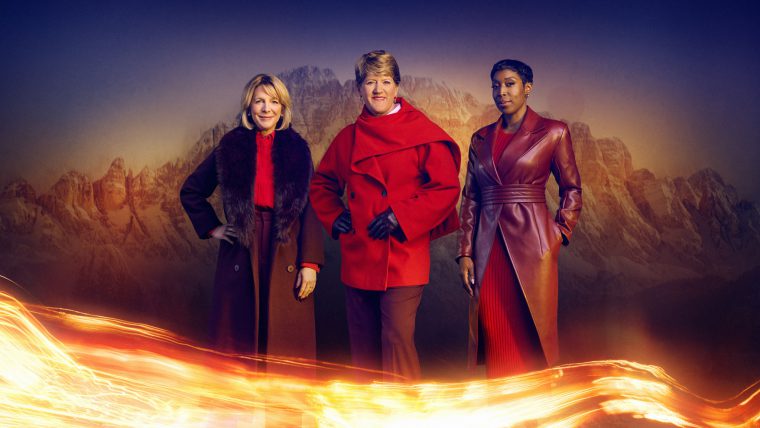
BBC’s Main Presenters Have No Winter Sports Experience!
Can you believe the three main studio presenters anchoring BBC’s Winter Olympics coverage (Hazel Irvine, Clare Balding, and Jeanette Kwakye) have no personal experience of winter sports whatsoever? None of them seem to have ever been skiing or snowboarding even on a ski holiday despite huge Olympic broadcasting experience.
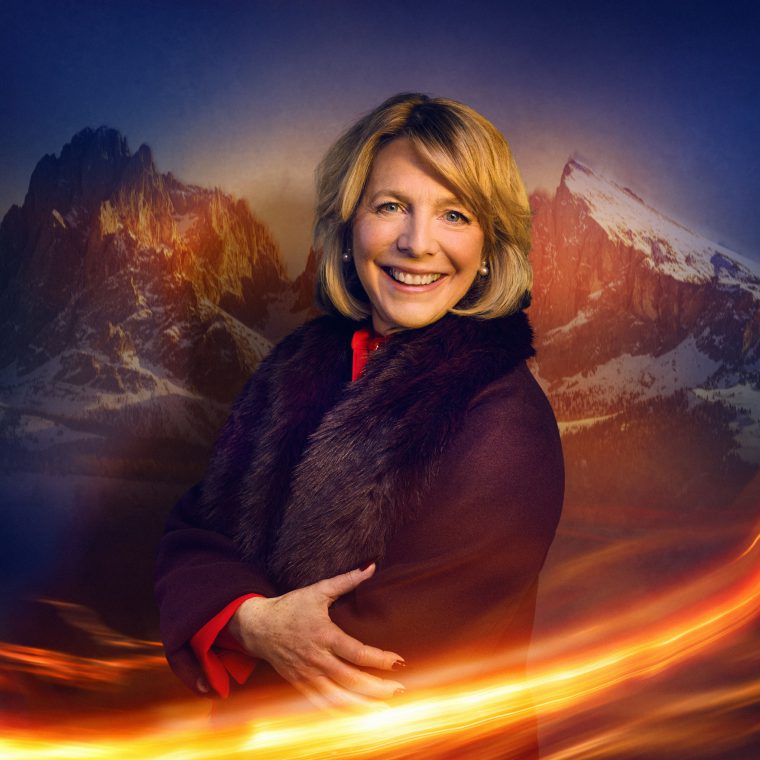
Hazel Irvine presented Ski Sunday for ten years (1996-2007) and has covered every Winter Olympics since Lillehammer 1994 but there’s no record of her ever hitting the slopes.
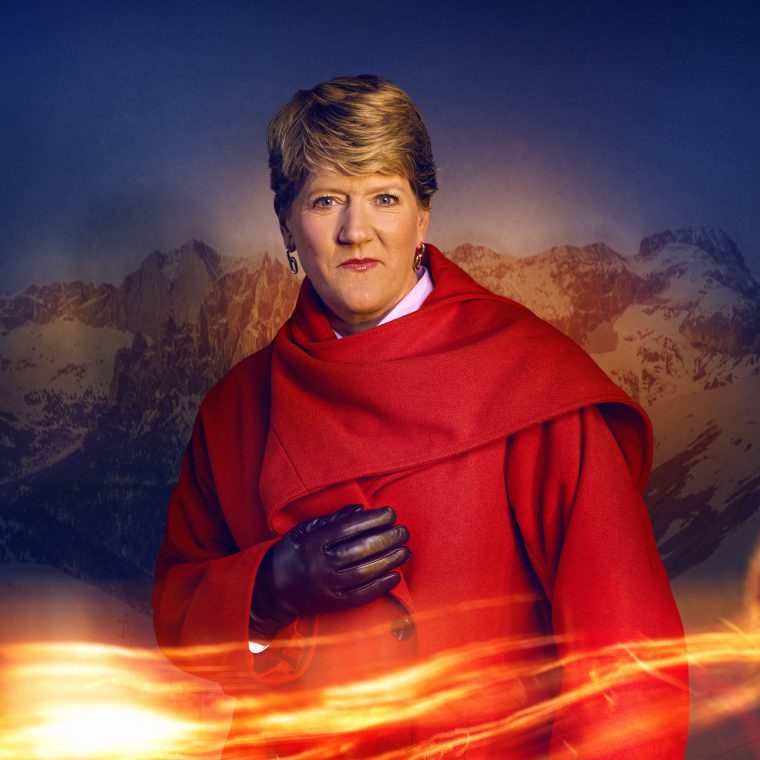
Clare Balding has presented lots of Winter Olympics (Salt Lake City 2002, Turin 2006, Vancouver 2010, Sochi 2014, Pyeongchang 2018, and Beijing 2022) but her sporting background is equestrian. Despite extensive winter sports broadcasting experience there’s no indication Clare has ever been skiing.
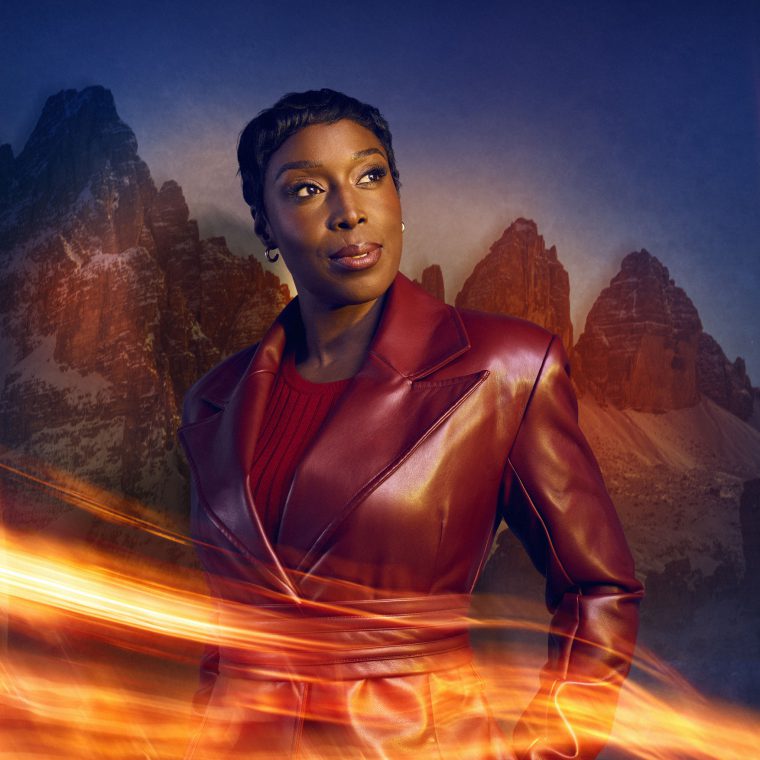
Jeanette Kwakye is a former 100m sprinter who represented Great Britain at the 2008 Beijing Summer Olympics. In an interview she did mention being ‘desperate to try’ skiing and snowboarding after her athletic career, which suggests she hasn’t yet.The BBC has assembled an impressive team of former Winter Olympic athletes as analysts and experts, but the choosing generalist presenters to front the coverage (rather than former athletes) contrasts TNT Sports.
BBC Winter Olympics 2026 Presenter Line-up
The BBC is providing over 450 hours of live coverage from Milano Cortina 2026 – a big increase from the 300 hours at Beijing 2022. It’s all “free-to-air” across BBC1 BBC2 iPlayer and the BBC Sport website so you don’t need a subscription.
Hazel Irvine MBE is one of the most experienced presenters in BBC sport having joined in 1990. Irvine presented Ski Sunday from 1996 to 2007 and has covered every Winter Olympics since 1994 and was awarded an MBE in the 2024 for services to sport and charity.
Clare Balding OBE CBE is one of Britain’s most recognisable sports broadcasters presenting major events for the BBC since 1998. An amateur jockey (1988-1993) and Champion Lady Rider, she has presented multiple Winter Olympics for the Beeb. Clare has won multiple BAFTA awards for her broadcasting work and an OBE and CBE.
Jeanette Kwakye MBE is a British sprinter who represented GB at the 2008 Beijing Olympics. After retiring from athletics she trained as a journalist building a broadcast career across athletics, football, boxing, basketball and swimming. Jeanette was the first Black female presenter to host boxing on UK TV and was appointed MBE in 2021 for services to sport and sports broadcasting before presenting BBC Beijing 2022 Winter Olympics coverage.
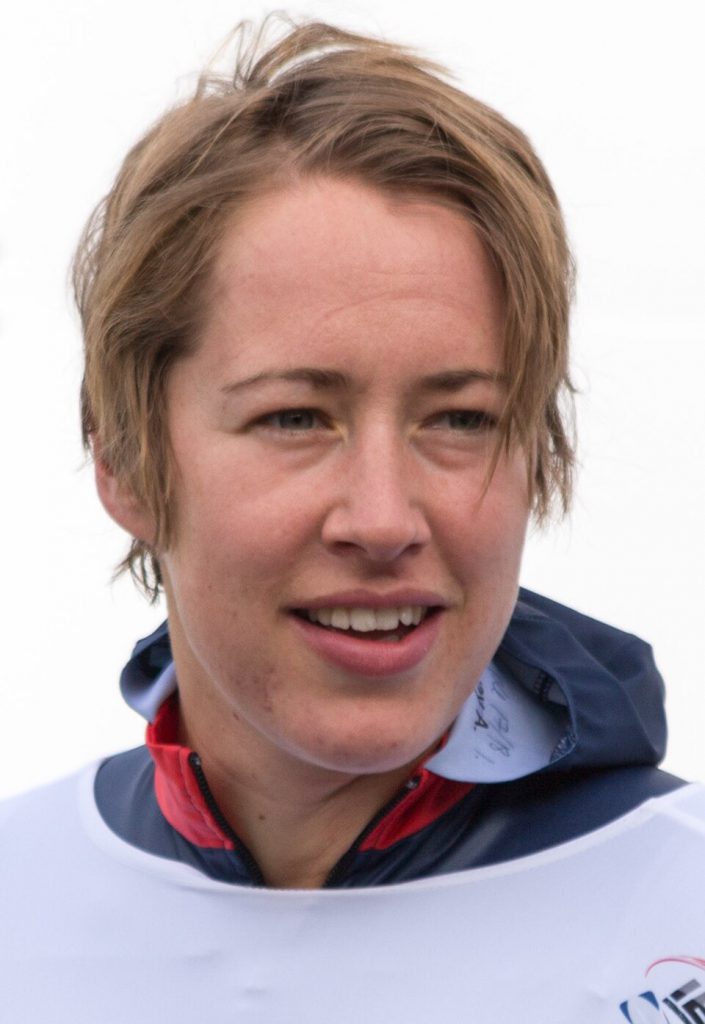
Lizzy Yarnold CBE providing expert skeleton analysis is Britain’s greatest Winter Olympian with two skeleton gold medals (Sochi 2014 and Pyeongchang 2018) and was the first Briton to successfully defend a Winter Olympic title.
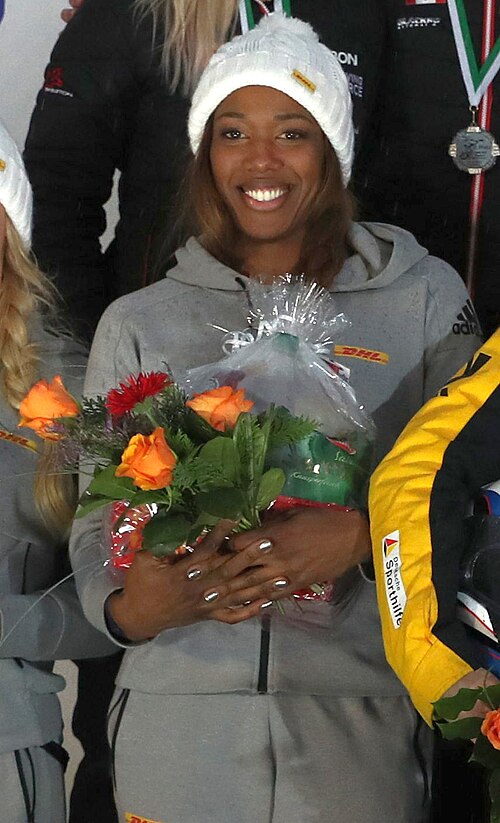
Montell Douglas (aka “Fire” on TV’s Gladiators) is a dual-sport athlete who competed in the 100m at the 2008 Summer Olympics then transitioned to bobsled to compete at the 2022 Winter Olympics.
Vicky Wright was curling Gold medallist at Beijing 2022 as part of Eve Muirhead’s victorious British team.
Robin Cousins – credit vagueonthehow
Robin Cousins MBE is of Britain’s most celebrated figure skaters after winning gold at the 1980 Lake Placid Olympics and has brought unparallelled expertise to BBC coverage in the decades since.
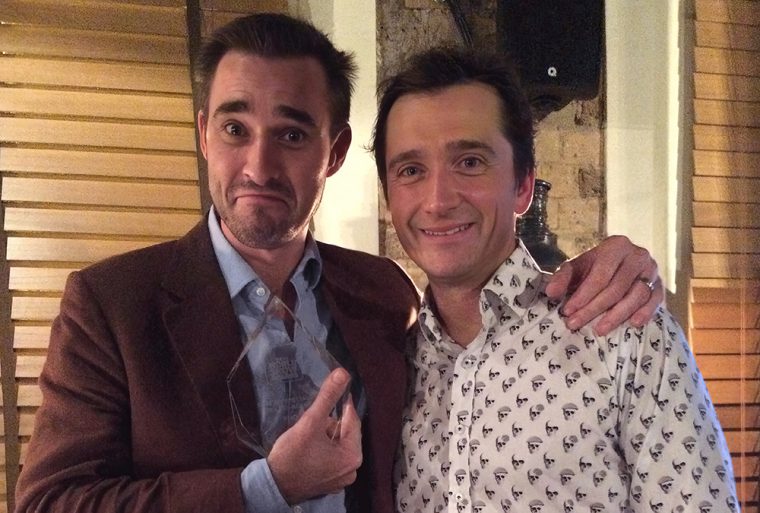
Graham Bell presenting SNOman (Richard Sinclair) with World Snow Awards winner’s trophy
Graham Bell MBE is a five-time British Winter Olympian in alpine skiing (1984-1998) and a former Ski Sunday presenter.
TNT Sports (formerly BT Sport) has the most hours of Winter Olympics coverage ever seen in the UK with over 850 hours of live action. It’s a subscription service with access to every event and multiple simultaneous streams so it might be preferred by fans who want to see everything.
Who Are The TNT Sports Presenting Team?
TNT Sports has taken a different approach to the BBC by using many former Winter Olympic athletes in the lead presenting roles.
Amy Williams MBE was Skeleton gold medallist at Vancouver 2010 and the first British individual gold medallist at a Winter Olympics for 30 years, bringing genuine expertise to the presenting role.
Aimee Fuller is a two-time Winter Olympian in snowboard slopestyle (Sochi 2014, Pyeongchang 2018) and previously a BBC presenter at Beijing 2022.
Eve Muirhead OBE was a curling gold medallist at Beijing 2022 and one of Britain’s most decorated curlers. She is also serving as Team GB’s “Chef de Mission” at Milano Cortina 2026 leading the entire British delegation while also contributing to the curling coverage.
Ed Drake is an alpine skier who represented GB and now leads TNT Sports skiing coverage.
Charlie Guest is a former British alpine ski racer providing expert commentary on slalom and other skiing events.
Lamin Deen is a former Team GB bobsled pilot (that’s the driver) who competed at Sochi 2014 and Pyeongchang 2018. Fun fact, our very own SNOman rode with the Brit Olympic driver and breakman in La Plagne back in the dim and distant past.
Which Should You Watch BBC vs TNT Sports?
Feature
BBC
TNT Sports
Total Hours
450+ hours
850+ hours
Cost
Free (TV Licence)
Subscription required
Main Presenters
Generalist broadcasters
Mix (many former athletes)
Expert Analysts
Former athletes in expert roles
Former athletes in lead roles
Coverage
Major events and Team GB focus
Comprehensive – every event
Streaming
BBC iPlayer
Discovery+
I think for Team GB’s medal hopes the BBC has good free coverage with experienced presenters and dedicated winter sports fans who want to see every heat, run and every obscure event might shell out for TNT’s full coverage.
What Are The GB Medal Hopes at Milano Cortina 2026?
While this guide focuses on presenters, it’s worth noting the British athletes these teams will be following. Our main medal hopes include:
Curling was considered Team GB’s strongest sport with both men’s and women’s teams competitive for medals. Sadly it wasn’t to be in the mixed doubles.
Skeleton is a traditional British strength so look out for Matt Weston and Marcus Mayfield on the men’s side.
Bobsled in Brad Hall’s four-man team does have medal potential.
Freestyle Skiing/Snowboard sees young British talent coming through in halfpipe and slopestyle events.
Key Dates for Your Diary
6th February 2026: Opening Ceremony in Milan
7th February 2026: First medals awarded
22nd February 2026: Closing Ceremony
I think the BBC’s approach of pairing experienced generalist presenters with former athletes’ analysts provides polished and accessible coverage but TNT Sports’ roster of former Olympians is more comprehensive if you want to binge on snowsports for the fortnight.
I do think it’s less than ideal the BBC’s main presenters have no personal winter sports experience but we have to wonder if any of them might finally take a ski lesson after Cortina… ladies please do call us at SNO Ski Holidays to arrange a beginner ski holiday once the games are over!
What Next For Olympic Winter Sports Lovers?
Are you feeling inspired to get back on the slopes this winter? You can browse the biggest selection of ski holidays online and filter by those from your nearest airport. May top tip is that the best deals right now are in March and April and you don’t need an Olympic ski resort to enjoy the magic of the mountains because the snow is amazing across the alps this year!
Ski holidays are being booked in record numbers by U.S. skiers discovering the Alps can offer better value, bigger terrain, and an altogether richer skiing experience. For US skiers, combining travel and culture with their snow-fix can “Make the Alps Great Again”.
The surge of American interest in European skiing is far outstripping the general growth in ski holidays: Switzerland recorded a 13.4% increase in American overnight stays during winter 2024-25, while Austria saw U.S. visitors jump 15.4% to nearly one million stays and France reported American visitor numbers up 10.6%. This winter 2026 is on course to break records again.
At SNO Ski Holidays we’ve seen a 35% increase in enquiries from American customers this season. It’s shocking when clients discover ski holidays in the Alps (with flights, transfers, accommodation, and lift pass) costs less than a week in Colorado, with one client saying “once we experienced the scale of the terrain and the quality of the mountain restaurants, US skiers and snowboarders will be converts for life.”
Some Americans come for the bigger ski areas and some for the culture and cuisine
The Swiss Are Seeing Record Breaking Arrivals Of American Skiers
Switzerland last winter recorded 18.5 million overnight stays which beat the previous year by 2.8% and it was American visitors driving the most growth. The Swiss Federal Statistical Office said U.S. tourists said “American visitors grew to 1.7 million overnight stays.”
“It was a rock solid good year. For America we had an amazing record” said Director of Switzerland Tourism Martin Nydegger, with total figures for the year increasing 13.9%.
Austria Is Approaching A Million American Visits In Wintersports Destinations
Statistics Austria says US skiers booked 973,000 overnight stays which is up 15.4% from 843,000 the previous ski season. To give this a bit more context Austria’s 2.38 million total US overnight stays that year was an all-time record.
Tobias Thomas, Director General of Statistics Austria said “this positive balance, achieved in the face of significant external pressures, underscores the robustness of Austria’s winter tourism sector.”
France Says Americans Are Driving International Growth
Domaines Skiables de France (official French ski industry body) reported American holidaymakers increasing 10.6% and Canadians up 21.3% (the “Trump Effect” saw much less Canadians sking in America so it seems they flew to Europe instead). Méribel ski resort alone reported a 59% increase in U.S. visitors.
Asked about the surge in North American visitors, the National Observatory of Mountain Resorts (ANMSM) and Atout France confirmed: “Growth is particularly marked among non-European customers.”
What SNO Ski Holidays Is Seeing
Our own booking data confirms this trend as SNO Ski Holidays has recorded a 31% year-on-year increase in American customer enquiries for Alpine ski holidays this season. Some of our US clients fly direct to alpine airports, but others have discovered the low-priced packages designed for UK skiers, and book a return packaged from the UK. “Some American guests fly into London first, combining a weekend of sightseeing with the convenience of departing on one of the hundreds of weekly charter flights to Alpine resorts.” This is a package deal that doesn’t exist when flying direct from the United States.
Snowboarding holidays are cheaper in Europe, but try to keep your après ski bill in check!
Ski any major American resort this winter and prepare for sticker shock because the daily lift ticket prices make a transatlantic flight look like a bargain.
Resort Daily Price Deer Valley, Utah $366 Vail, Colorado $322 Park City, Utah $302 Aspen, Colorado $293 Jackson Hole, Wyoming $268
European Resort Daily Prices
Resort Daily Price St. Anton, Austria €85 (~$100) Les 3 Vallées, France €86 (~$101) Courchevel, France €91 (~$107) Verbier, Switzerland CHF 93 (~$117) Zermatt, Switzerland CHF 93 (~$117)
The maths are stark (translates as “the math is stark” for our US readers) with Europe’s most expensive resorts costing less than half of America’s major destinations for a week’s ski pass. These walk-up prices can drop further if you book a package deal through a UK tour operator like SNO Ski Holidays, with regular lift-pass deals like BOGOF and even Free Ski Pass for early bookers.
A third of the price for more trails and ski lifts.
SNO Ski’s Price Comparison Of Ski Lessons In USA vs EU
U.S. Resort Half Day Private Lesson
Resort Half Day Price Vail, Colorado $955 Breckenridge $945
European Resort Half Day Private Lesson
Resort Half Day Price Zermatt, Switzerland CHF 87 (~$100) Courchevel, France €91 (~$107)
SNO Ski Compares Europe vs US Food And Drink In Ski Resorts
U.S. Ski Resort Beer
Resort Beer Price Park City, Utah $9 Aspen, Colorado. $12
European Ski Resort Beer
Resort Beer Price Verbier, Switzerland CHF 8 (~$10) Val d’Isere, France €10 (~$10)
Food and drink prices are very similar between ski resorts in the two continents, but the perception of quality is not always. “I paid $8 for a brown hot water masquerading as coffee in Vail,” Sammy Salm, CEO of Best of the Alps, told CNN. “For the same price in St Anton recently, I had a double espresso with a Schnapps shot and whipped cream on top.”
Why Is It So Much Cheaper To Ski in Europe Than The USA?
We think the price disparity stems from different markets of skiing in Europe and North America. According to Laurent Vanat’s International Report on Snow & Mountain Tourism, Europe has around 4,000 ski resorts serving 448 million people, while the U.S. has barely 500 for 332 million population. Eight times more resort options per capita in Europe creates more competition, while American corporate consolidation has also been pushing prices in the opposite direction. According to the Financial Times, Vail Resorts and Alterra Mountain Company now control nearly half of the North American ski market and this dominance have given them total pricing power, especially in the peak periods.
Does Currency Conversion Affect The Cost Of Skiing In Europe vs America?
The weakened U.S. dollar hasn’t really eroded that difference in cost/value and Nydegger noted, “The strong franc is nothing new for tourism in Switzerland. Regular visitors tend to be immune to crises and committed to their travels.” Even with exchange rate fluctuations, the price difference is pretty dramatic with an €82 lift ticket converting to $98 being less than a third of the cost of Vail.
“American skiers are doing the maths,” says Richard Sinclair of SNO Ski Holidays. “When your lift ticket is $320 a day at Vail but you can get a week’s package vacation in the Alps for less than that per day, including flights, accommodation, and lift pass, it’s no wonder snow lovers are crossing the Atlantic.”
A Skiing And Holiday Experience Americans Can’t Find at Home?
I Think European Mountain Dining Transforms Your Day’s Skiing
In my experience the European skiing culture differs from the American “shred as much vertical as possible” approach as SKI Magazine said “the dining, both on and off the slopes, blows American ski lunches to pieces,” when comparing a quick cafeteria-style US lunch “expect to sit down, order off a menu and indulge in homemade dishes that often represent the region you’re skiing in. That meal by the way will cost half of what you’re used to paying for your heat-lamp-warmed nuggets fries and Coke.”
Skiing all across the Alps, American clients just like the Brits love stopping at a mountainside restaurant – in Austria for Kaiserschmarrn with a view of the Matterhorn, or lingering over a three-course lunch at a Savoyard refuge in France. The concept barely exists in American skiing, where the goal seems to be minimising time off the slopes rather than embracing it as part of the experience.
Après-Ski is a Cultural Institution in Europe
The après-ski tradition in Alpine resorts bears little resemblance to American counterparts as VinePair’s Adam Teeter describes from a scene in Switzerland. “Inside the bar, the music is pumping, turned up to maximum volume… It’s a madhouse, raucous shouting coming from all directions as the dance floor’s neon lights cast a luminescent glow. The scene recalls the rowdiest nightclubs of Barcelona when the hour nears 3 a.m. Only, rather than 3 a.m. in Barcelona, it’s 3 p.m. in Zermatt.”
In my experience the difference is one of skiing philosophy as American skiing prioritises vertical feet and run counts whereas European skiing treats the mountain and village as a destination in itself.
Europe’s Bucket-List Ski Resorts Have A Long And Often Quite Ancient Heritage
The great Alpine resorts like Chamonix, Zermatt St Anton, St Moritz and Cortina evolved from traditional mountain villages and were not started as purpose-built as ski resorts. Skiing history was made here when the sport’s pioneers first strapped on wooden boards and pointed themselves downhill and this heritage is palpable in every cobbled street and centuries old church spire.
For Zermatt the U.S. has become the second most important market (was third before covid) with American overnights more than doubling since pre-pandemic. According to Switzerland Tourism, approximately 20% of skiers visiting Zermatt are now U.S. citizens, drawn by the iconic Matterhorn views and 360km of prepared trails.
Are Americans more worldly/adventurous now? The % of passport holders is growing.
Scale Of Ski Areas Tips the Balance
European Terrain Dwarfs American Competition
The size difference between European and American ski areas is pretty dramatic, with the biggest in the USA being only 13th largest in the world and all the Top 10 biggest ski resorts being on the Alps.
Resort
Terrain
Les 3 Vallées, France
600 km of pistes, 159 lifts
Portes du Soleil, France/Switzerland
580 km of pistes, 165 lifts
Ski Arlberg, Austria
300 km of pistes, 85 lifts
Vail, Colorado (largest U.S.)
~100 km equivalent
Park City, Utah
~140 km equivalent
Les Trois Vallées (The 3 Valleys) alone offers roughly four to six times more terrain than the largest American resorts. European interconnected systems allow skiing across multiple villages and even multiple countries on a single pass so you can start your day in Méribel, have lunch in Courchevel and finish in Val Thorens without removing your boots.
High-Altitude Slopes Guarantee Good Snow Conditions And There’s More Of Them In The Alps
High-altitude skiing provides superior snow reliability and it’s important to factor the percentage of trails above 2000m rather than just looking at the summit height. Val Thorens sits at 2,300m village elevation with skiing to 3,230m and Zermatt offers glacier terrain reaching 3,899m and lots of European resorts have a majority of terrain above 2,000m. Year round glacier skiing at destinations like Hintertux, Cervinia and Zermatt (open 365 days) makes a totally snow-sure vacation and this winter faring less well for snowfall in the US this has added to the number of skiers flying across the Atlantic.
Some Of Our Clients Come To Escape The American Overcrowding & Lift Queues
The 2024-25 US ski season recorded 61.5 million skier visits which is the second highest ever according to the National Ski Areas Association (NSAA) and four of the five highest-visit seasons ever have happened since the 2021 post pandemic boom.
There’s an argument to say the Epic and Ikon passes have concentrated crowds at their partner resorts and Telluride now needs advance reservations for Epic Pass holders and limits their access to seven days. The irony isn’t lost on American skiers, that they bought unlimited passes only to find their access limited.
Mega-Pass Integration Has Opened European Doors For USA Skiers Keen To Travel
New deals/partnerships mean the expansion of multi-resort passes has made European skiing more accessible to American pass holders.
Epic Pass (2025-26) now includes 34 European resorts:
Dolomiti Superski in Italy reported 30% YoY increase to 12,350 Ikon Pass customers by mid-season last winter. “It looks like joining Ikon Pass was a great chance for Dolomiti Superski to conquer the hearts of North American skiers,” said Diego Clara, PR representative for the Italian ski consortium.
Switzerland Tourism reports that Zermatt recorded approx. 50,000 Ikon skier-days in recent seasons and 2026 looks to be even bigger. Veteran ski travel journalist Patrick Thorne has canvassed opinion each time he hears an American accent and reports directly from the Alps today that “anecdotally many US skiers tell me their Epic or Ikon pass first made them consider skiing in Europe,” and this leads to discovering how much cheaper it is in Europe, along with how much bigger are the giant linked ski areas.
Direct Flights Make the Alps Accessible From America
Multiple carriers serve key Alpine gateway airports from major U.S. cities, with our most booked being Swiss (clients love the free ski carriage) United and American Airlines.
Swiss International Airlines operates direct flights from New York, Chicago, Los Angeles, San Francisco, and Miami to Zurich and Geneva with increased frequencies for winter 2024-25 and many flights still include free ski carriage.
United Airlines flies a year-round Newark-Geneva service with frequency increasing in the most peak winter periods.
American Airlines expanded European leisure routes quite a bit for 2025 including adding a Philadelphia-Milan service with Boeing 787.
Geneva is the biggest gateway to the French Alps (Chamonix within one hour) and Swiss Valais (Verbier, Zermatt). Zurich connects to Swiss and Austrian resorts with really efficient train transfers. Overnight flights from the U.S. arrive early morning in Zurich or Geneva. Our American customers often ask about the chocolate-box pretty Swiss Rail transfers between airport and ski resort.
The UK Connection Creates A Smart Route to the Alps
Many of our American clients have discovered the unexpected advantage of routing their Alpine ski holidays through London. The UK ski holiday market is very competitive with dozens of suppliers offering packages that bundle flights, transfers, accommodation and lift passes. These packages from London airports can often save enough to add a sightseeing city-break at the start of the ski trip, and it’s great to have transfers included if the idea of driving rental cars in the alps makes you nervous.
American guests who fly into London for just a day or two of sight-seeing then join one of our package departures to the Alps. They get the best of both worlds, starting with a cultural city break before an affordable ski holiday, with the total often less than a simple ski trip in the States.”
With London to Geneva a 90-minute flight and Chamonix an hour’s taxi, the geographic proximity of the UK to the Alps combined cheaper British tour operators creates efficiencies that Americans can take advantage of.
Social Media & the Cachet of Skiing Europe Has Amplified Alpine Appeal
The NSAA reports that 73% of skiers check resort social media channels for conditions before visiting but the influence extends far beyond snow reports. The visual drama of Alpine skiing translates perfectly to Instagram and TikTok, and European resorts have capitalised.
Followers to the 3 Valleys (213k) Instagram accounts including Val Thorens (372k), Courchevel (321k), Meribel (108k) totals over one million follows, with gen-Z in particular prioritising authentic experiences and social media shareability.
We also know there’s a certain cachet to skiing in Europe, conferring a sense of sophistication and worldliness on Americans who choose the cross the Atlantic to embrace other cultures as well as other mountains. The iconic Matterhorn is a big reason almost a fifth of Zermatt’s skiers came from the States this winter, as is Chamonix’s Mont Blanc. Some Americans come to ski the massive mileage of the Alps but most tell us their top reason is the bucket-list mountains, authentic alpine charm and the famous French, Austrian and Italian cuisine… and infamous après ski!
Is This A Permanent Shift in American Skiing Behaviour?
The surge of American skiers to Europe has grown far beyond a post-pandemic travel rebound because of this big recalculation of value. Europe’s most expensive lift tickets can often cost less than a third of those in America’s cheapest major resorts and Alpine terrain offers four times the skiing area. If you’re also an American keen to enjoy mountain culture and authentic old-world experiences, you can see why the longer flight is easily worth the extra few hours.
Laurent Vanat (International Report on Snow & Mountain Tourism) said the “…decline of the number of skiers on the Western market did not really happen as expected, with ageing baby-boomers keeping on skiing, even if it is less frequently,” but the data now shows where they’re choosing to ski and Europe is winning.
Isabelle Rapisarda, North American Customer Manager for Jungfrau Region Tourism noted “we are seeing renewed interest from Canadian visitors. Scarred by tensions between the two countries, they are avoiding destinations in the US in favour of Europe and Switzerland.”
The trend is accelerating as American lift ticket prices continue to climb and European resorts invest in their infrastructure and international marketing.
Switzerland Tourism’s Nydegger said for American visitors, winter 2024-25 was “an amazing record.” At SNO Ski our 2025-26 season bookings suggest another one.
Key Statistics Summary
Metric
Figure
Source
Switzerland winter overnight stays (2024-25)
18.5 million (+2.8%)
Swiss Federal Statistical Office
U.S. visitors to Switzerland ski season
+13.4% (1.7M stays from Americas)
Swiss Federal Statistical Office
Austria winter overnight stays (2024-25)
72.38 million (+1.8%)
Statistics Austria
U.S. overnight stays Austria (2024-25)
973,000 (+15.4%)
Statistics Austria
France skier visits (2024-25)
54.8 million (+5.5%)
Domaines Skiables de France
American visitors to France
+10.6%
ANMSM/Atout France
U.S. ski resort visits (2024-25)
61.5 million (2nd highest ever)
NSAA
SNO Ski average European lift ticket
~€87/day (~$102)
SNO Ski Holidays research
SNO Ski average U.S. top-resort ticket
~$310/day
SNO Ski Holidays research
SNO Ski American customer enquiry growth
+35% year-on-year
SNO Ski Holidays
About This Article
SNO Ski Holidays is the UK’s leading skiing and snowboarding vacation specialist. SNO Ski is an ATOL protected tour operator offering over one million ski holiday combinations both tailor-made to clients’ precise requirements and with 60+ suppliers as a fully bonded ski travel agent. With the biggest selection of ski chalets, hotels and apartments in hundreds of destinations, including all the world’s most popular ski resorts, SNO Ski is the only UK ski operator to exceed 95% 5-star reviews and Trustpilot rating 4.9/5.
Sources:
Swiss Federal Statistical Office
Statistics Austria
Domaines Skiables de France
National Observatory of Mountain Resorts (ANMSM) / Atout France
National Ski Areas Association (NSAA)
Laurent Vanat, International Report on Snow & Mountain Tourism
Switzerland Tourism
SNO Ski Holidays proprietary data
Financial Times
SKI Magazine
CNN Travel
VinePair
For media enquiries contact SNO Ski Holidays, or to quote from this article please include a link to sno.co.uk
For our American pals planning to ski in Europe, browse and filter over a million ski holiday deals or email snoman@sno.co.uk for help choosing your perfect trip.
Some skiers will tell you skiing Ischgl for beginners is a terrible idea but I know why they’re entirely wrong.
This is definitely a resort loved by confident intermediates who want to ski hard and party harder. The only pisted route back to the village is a red run, there’s no discounted beginner lift pass and the learning area sits at 2,300 metres altitude so beginners should the gondola down to resort.
And yet Ischgl keeps attracting beginners, because skiers and snowboarders can’t wait to bring others here – couples where one person skis and the other doesn’t, groups of friends who want the full Alpine experience rather than a quiet week on nursery slopes, and families who’ve decided that if they’re spending money on a ski trip, they want world-class restaurants and a spa to go with it.
SNOman skiing with beginners in Ischgl
So my personal guide is not that “Ischgl is secretly perfect for beginners” but that it can easily work for a first timer and might even be your top choice, if you want top-drawer après to round off your days learning.
Ischgl village sits at 1,377 metres in the Paznaun Valley and it’s compact, wealthy, traditionally Tyrolean but with plenty of contemporary architecture mixed in. The key thing beginners need to understand is that almost no skiing happens at village level so don’t let the lower village altitude worry you (it’s actually better for a good night’s sleep).
Three gondolas depart from the village and the Silvrettabahn (A1) and Fimbabahn (A3) both arrive at Idalp (2,300m), which is the main hub where the ski school operates and beginners spend most of their time. The Pardatschgratbahn (A2) is an impressive tricable gondola which climbs to 2,650 metres and more challenging terrain but you won’t need it as a beginner.
The full Silvretta Arena spans the Austrian-Swiss border and connects the duty-free village of Samnaun with 46 lifts serving 239 kilometres of piste across 515 hectares. The vertical drop is 1,495 metres from the 2,872-metre summit down to the village but 90% of this piste is above 2,000 metres so the snow is pretty reliable in my experience.
What is the Terrain breakdown in Ischgl?
Blue runs: 47km (approximately 20%)
Red runs: 143km
Black runs: 34km
Ski routes (unmarked): 15km
That 47km of blue is what many small resorts have in total but here it’s all at higher altitude, which is often much nicer snow to learn on. It’s really important that you don’t try to ski down to the village though, because the few reds to get down on can get crowded and icy – I always bring beginners and lower intermediates down in the gondola because there’s really no point in knocking your confidence.
What do Beginners Need to Know about Skiing at Altitude in Ischgl?
Learning to ski at 2,300 metres is a little bit different from learning at 1,400 metres because the air is thinner, which means you tire more quickly than expected, so don’t be surprised if you’re exhausted by lunchtime on the first day and make sure you have lots of breaks and drinks. UV exposure is much higher above 2,000 metres so you must wear strong sunscreen (even on overcast day) and it gets much colder as you go higher so I tie an extra layer round my waist if I get too warm (but don’t be caught without enough layers).
Most clients adjust within a day or two and arriving the day before lessons start does give your body extra time to start to acclimatise. It’s not particularly tough if you drink plenty of water and go easy on alcohol the first night – don’t push through exhaustion on the slopes because altitude fatigue affects your balance and concentration.
I personally think learning to ski higher up is a much nicer experience because the snow quality is more reliably good with less chance of having to deal with slushy or icy runs.
Take the gondola back down, as the run to resort is not beginner-friendly
Where Should Beginners Learn To Ski In Ischgl?
The Idalp Nursery Area
Your first days will be spent on the Idalp plateau right outside the ski school building, where the main nursery area has covered magic carpet lifts (B9 and B10) serving gentle slopes with plenty of space to learn the basics of clipping-in and standing, snowplough stops and your first turns.
Once you’ve got basic control the T-bar lifts (B6 and B7) access slightly longer runs at the Viderböden practice area. T-bars are harder than chairlifts but the extra work to master them is part of learning to ski and everyone looks back on them fondly (eventually) so focus on letting them push your derriere instead of trying to sit on it.
Sonnenbahn Will Be Your First Chairlift In Ischgl
The Sonnenbahn chairlift opens up your options once basic turns feel reliable around day three and this is a family-friendly lift gives you the gentlest blue run in the resort which is wide, mellow and south-facing (learn in the sun most of the day). Below the main run there’s a curving slope once you’re feeling more confident.
What About Progressing to Longer Blues?
By day four or five with regular lessons you can start exploring longer blue runs that return to Idalp and here are my favourites:
Piste 6 (from Pardatschgrat) is a mellow cruising blue with good afternoon sun and views across the valley.
Piste 8 (from Velillbahn Berg) is served by a comfortable six-person chairlift (a little break from T-bar stress) and is similar difficulty to Piste 6.
Piste 11 (from Idjoch) links directly from the Idalp area and debutantes tend to like the longer run without much step-up in difficulty.
Piste 60 (to Samnaun) is a blue-graded run that crosses into Switzerland but it’s no harder than the others. Siing across an international border feels like an achievement but bring your passport as there’s a customs post on the return.
What Areas Should Beginner Skiers Avoid in Ischgl?
Piste 1 (Talabfahrt) is the only pisted run back to the village and it’s red-graded, steep in sections, often crowded at the end of the day, and can become icy by afternoon. Beginners should not attempt this and instead always download on the Silvrettabahn gondola which takes only five minutes. Plenty of intermediate skiers choose the gondola over that run too when conditions are tougher.
Höllboden bowl contains the resort’s steepest terrain with gradients up to 70% and it’s far too risky for a newbie.
Anything from Greitspitze which is basically expert black runs and also avoid piste 14a (Lange Wand)which is the steepest piste in the resort.
Which Ischgl Ski Schools and Lessons to Book?
Skischule Ischgl A.K.A. the Schneesport Akademie
The resort’s main ski school has been operating since 1930 and has between 100 and 160 qualified instructors depending on the season speaking German, English, Dutch, Danish, French, Russian, Czech and Swedish. We can arrange lessons for you if your ski holiday is booked through SNO Ski, but their contact details are:
Address: Silvrettaplatz 2, 6561 Ischgl
Phone: +43 5444 5257
Website: www.skischule-ischgl.at
And their office locations and hours are:
Silvrettabahn (village) from 8:00am ‘til noon and 2:00pm to 5:00pm
Idalp (mountain) from 8:30am to 3:30pm
Pardatschgratbahn opens 8:00am until noon and 2:00pm until5:00pm
Adult group lessons range from €60 to €94 per day for four hours of instruction from Sunday to Thursday, with a three-day course costing €149 and five days €189. For complete beginners I think the five days is ideal but three is still great if your budget is a bit tighter.
Children’s group lessons range from €55 and upwards per day (from age 4) and they’re four hours of instruction with a similar course structure to adult lessons.
Bambini programme (ages 3–5) can be a full day including lunch for €95 or mornings only for €63 and SNO clients have recommended the kindergarten (from age 2) for non-skiing childcare.
Private lessons start from €160 for 90 minutes and €195 for two hours, which sounds expensive but the personalised attention gives you faster progress and more flexible timing.
Tyrolean Alpine Ski School
Run by Gerald Kurz and is a smaller alternative for private instruction that’s been operating since 1994, with rates starting at €150 for 90 minutes and €195 for two hours or €275 for three hours.
Address: Unterer Nederweg 18, 6561 Ischgl
Phone: +43 5444 5956
Website: www.alpinskischule-ischgl.at
What’s Your First Week Like Learning To Ski In Ischgl?
Days 1–2 covers the basics so arrive on Saturday if possible to give yourself a rest day before lessons start to collect your rental equipment, explore the village and get an early night. Everyone says day one with ski school the boots feel awkward, the skis won’t do what you want and you’ll be more tired than expected by lunchtime. You’ll have a go at magic carpets, snowplough turns and lots of falling over and day two is more of the same but moves that felt impossible start to get easier.
Day 3 can be a bit of a breakthrough as things can start to click and the T-bar lifts stop being so tricky. You might take the Sonnenbahn chairlift for the first time so tell your instructor if getting on or off makes you nervous and they’ll ride alongside to help you.
Days 4 and 5 are the start of proper skiing because you’ve got the fundamentals established and might venture onto longer blue runs. Pistes 6, 8, and 11 all return to Idalp and give you the excitement of skiing beyond the nursery slope because you’re covering more distance, enjoying scenery and feeling a bit of (very modest) speed.
Days 6 (and maybe 7) are so fun because lessons have finished and you can just “go skiing”. Practise what you’ve learned on familiar terrain and if it’s going really well try the blue run to Samnaun (Piste 60) for a bit of an adventure but don’t spoil it by going for harder terrain.
This is where you want to be aiming for – Ischgl skiers’ heaven!
Ischgl Ski and Snowboard Equipment Rental For Beginners
Silvretta Sports has five locations including both valley and mountain stations and their VIP package lets you swap skis up to three times in the week if the first pair doesn’t feel right. They also have a test centre at Idalp but don’t consider buying skis or board in your first winter.
Ischgl Rent (Shop Prenner) has three locations (Zentrum, Prenner, Check In) but we haven’t worked with them so I can’t comment on prices or quality.
MIETSKI at Dorfstraße 51 in the village centre claims all equipment is new each season with packages from around €46 per 6-days for basic skis and poles.
Sport Adler on Dorfstraße 75 near the Silvrettabahn has a “seven days for six” offer and test-and-buy options.
HERVIS Rent is in the village and children under 10 get free equipment when a parent rents a full package of skis poles and boots.
I recommend you should rent skis, poles, and boots as a package because it’s cheaper and you have just one point of contact if skis or boots need adjusting/swapping. Helmets are now standard but focus on getting boots fitted really well because badly fitting boots will ruin your week.
Ischgl Lift Passes for Beginners
Ischgl does not offer a beginner-only lift pass and to access Idalp and the nursery slopes you need the full VIP Ski Pass covering all 46 lifts in the Ischgl-Samnaun Silvretta Arena but… there are discounts for kids and low-season:
VIP Ski Pass prices (2025/26 season)
6-day adult varies from €292 to 323 depending on season
Children under 10 ski FREE when accompanied by a paying parent
The pass requires an Ischgl/Mathon guest card, which you can get from your accommodation.
Discounted periods
START season 27th November to 19th December 2025
POWDER season is from 10th to 24th January 2026
FIRN season is from 11th April to 3rd May 2026
Alternative is the Silvretta Ski Pass which is a broader pass covering 76 lifts including the smaller resorts of Galtür, Kappl, and See. Children under 8 ski free with a paying parent and senior discounts are available but are you really likely to explore these nearby areas (which you have to drive to)? Galtür has excellent beginner slopes at village level but I would say you’re better using that commuting time to ski more and rest more in Ischgl.
Is paying full price for access to 239km of piste (when you’ll use 20km) annoying? Yes it is a bit but there’s no alternative in Ischgl I’m afraid.
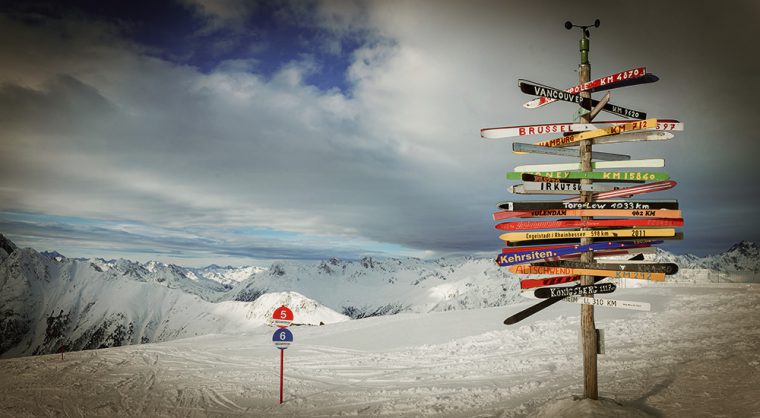
Ischgl’s famous piste signpost is not helpful for a beginner but the little blue piste on the left is
Which Mountain Restaurants in Ischgl Can Beginners Can Ski To?
At Idalp (no skiing required to reach these) I recommend:
Restaurant Idalp Panorama has two floors with self-service downstairs and table service upstairs serving regional Tyrolean specialities on a nice terrace with views. Self-service mains range from €12-24.
Alpenhaus is more expensive but I think it’s one of the most stylish mountain restaurants in the Alps and has a great combo of contemporary design with high-end food a few metres from the gondola stations.
Vider Alp is a good-value traditional Tyrolean ski hut with wooden interiors and hearty regional cooking and an outdoor ice bar.
Paznauner Taja has self-service and is also a bit of a party venue from lunchtime onwards with DJs and dancing etc.
Bergrestaurant Pardorama is up at 2,600m with three floors and panoramic views which you need to take the Pardatschgratbahn to reach but you can get here without skiing.
On the Swiss side I really like:
Schmuggler-Alm for its’ restaurant with après-ski and duty-free shopping in one when you’ve skied over to Samnaun.
La Marmotte is a Gourmet restaurant at Alp Trida for a more refined lunch and has gluten-free and lactose-free options with (in my experience) amazing pizza but generally quite small portions.
Where are the Best Locations for Beginners to Stay in Ischgl?
Near the Silvrettabahn is the prime spot for learners and hotels along Dorfstraße offer the shortest walk to the main gondola accessing Idalp. It’s nice to be in ski school faster and back for après-ski without trudging through the village in ski boots as learning is knackering enough already.
Village centre is a compact and keeps you within walking distance of all three main gondolas, plus restaurants, bars and shops. An escalator connects the different village levels which helps when you’re carrying equipment and/or kids.
Is there a More Budget Alternative to Staying in Ishcgl?
Accommodation in Ischgl proper tends not to include the cheaper end of the spectrum but staying in nearby villages like Mathon (on the same bus route), Galtür, Kappl or See cost between 20–30% less. All are connected by free ski bus but you lose some convenience and have to ask whether you’re really doing Ischgl (I wouldn’t be hitting the après ski so hard if I had to commute home at the end of it).
Ischgl Accommodation Types tend to nbe more upmarket with five-star properties like the Trofana Royal and Schlosshotel Ischgl being my favourites with rates starting a €300+ per night. Mid-range four-star hotels like Hotel Garni Mondin or Hotel Goldener Adler start from €150 per night and self-catering apartments are our best value options from €85 per person per night. If you chat to the team about what kind of holiday you’re looking for, we will help you find the best option for your budget
What about Ski-in/ski-out Accommodation in Ischgl?
True ski-in/ski-out is limited in Ischgl (and non-existant for beginners) because the valley runs are red-graded. Until you’re confident on reds you should be downloading by gondola at the end of each day regardless of where you stay so it’s not worth paying more for ski-in/ski-out.
What is there To-Do Beyond the Slopes in Ischgl?
If Ischgl great for rest days or half-days off the slopes and here are some of our client’s faves for a bit of a rest day or half day off skiing or for non-skiers in your party.
Silvretta Therme opened in December 2022 as a thermal spa complex spread across four floors with over 1,000 square metres of water including:
25-metre indoor/outdoor sports pool
Adventure pool and rooftop outdoor pool with mountain views and swim-up bar
1,500 square metres of sauna area (five saunas, two steam baths)
320 square metre fitness centre
Your 4+ day ski-pass also gives 20% discount on entry during promotional periods.
Is Ischgl Good For Après-Ski?
Ischgl claims to have invented Austrian après-ski (or at least ‘posh après’) and remains the benchmark with Kuhstall at the Silvrettabahn base station kicking off when lifts close with live music, dancing and crowds spilling onto the street. Schatzi Bar (opposite the Pardatschgratbahn) and Kitzloch (near Pardatschgratbahn and famous for spare ribs) are great alternatives and later on Pacha nightclub in Hotel Madlein is the biggest late/all night venue.
Ski boots and carrying skis is banned in the village after 8pm and you can be fined up to €2000 so make sure you end après ski in time to go back and get changed beforehand.
Top of the Mountain Concerts three times per winter are my big highlights for the season opening, Easter and closing. These free concerts feature major international headliners like previous performers Robbie Williams, Elton John, Rihanna, and Alicia Keys. Entry is included with your lift pass and I really think it’s worth booking your Ischgl ski holiday to coincide with them! 2025 opening concert on 29th November was headlined by Alicia keys and the closer 2nd May 2026 is Christina Aguilera.
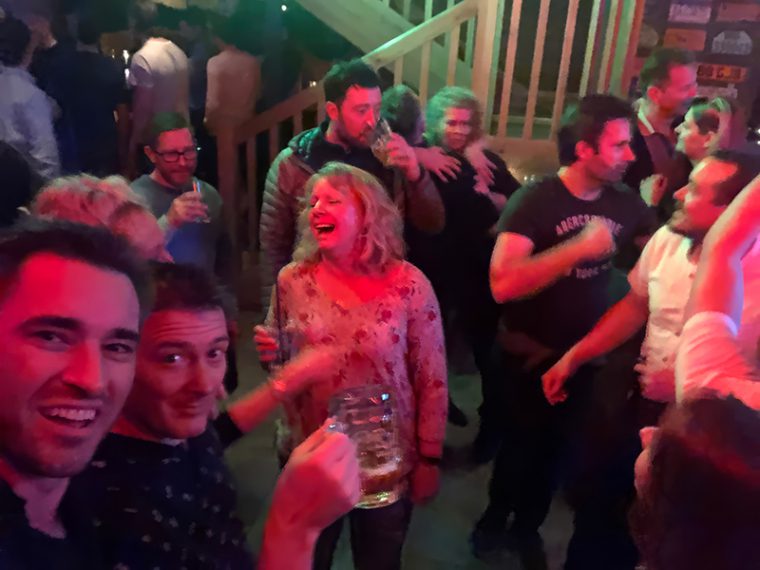
SNOman and pals from Inghams “researching” Ischgl après ski on your behalf
Tobogganing on the 7km floodlit run with night sessions on Mondays and Thursdays
Ice skating at Silvretta Center
Cross-country skiing on 74km of trails in the Paznaun Valley
Winter hiking on 100km of cleared paths
Duty-free shopping if you take the lifts to Samnaun for tax-free watches, spirits and perfume etc
Ischgl Après Ski Guide to the Best Bars Clubs and Nightlife
Ischgl Skiing For Mixed-Ability Groups
This is where Ischgl makes most sense for beginners because the resort has 143km of red runs and 34km of blacks, plus 15km of ski routes for off-piste exploration so advanced skiers in your group won’t feel remotely held back. Meanwhile beginners are well-looked-after on good nursery slopes and pro instruction progressing at their own pace without pressure.
Meet for lunch at Idalp which is central to everything and later reconvene for après-ski which you can learn without lessons 😉 Evenings together in restaurants the spa and the bars and nightclubs plus all the non-skiing options mean everyone is holidaying together regardless of skiing level.
Should You Learn To Ski Galtür Instead?
It’s worth considering as Galtür is 15 minutes up the valley and has village-level nursery slopes and a more relaxed atmosphere plus lower prices and terrain weighted toward easier blues. If learning to ski as quickly and cheaply as possible is your sole priority, Galtür probably makes more sense but I would not recommend it if what you’re really going for is the real Ischgl experience as it lacks Ischgl’s restaurants, nightlife, spa and general buzz. It’s a lovely quiet village for a quiet week but not the same experience.
The Silvretta Ski Pass covers both resorts so you can stay in Galtür for the savings and visit Ischgl for a day or two when you want the bigger ski area or livelier après-ski but I would find myself a bit disappointed at having to leave the nights out early to get home.
Budget Planning and Being Realistic About Ischgl Ski Holiday Costs
Skiing essentials per person for one week:
Lift pass (6 days) costs €292-323 depending on season
Ski school (5 half-days) starts at €185
Equipment rental costs from €100-200 for 6 days skis and boots
Total skiing costs: roughly €580-800
Add accommodation (€80-300+ per night) food, drinks and transfers and your week in Ischgl realistically costs £1,500-3,500 per person depending on where you choose to stay eat and party.
Money-saving options:
Visit during START, POWDER or FIRN discount periods (ask my team)
Stay in Mathon, Galtür, Kappl, or See rather than Ischgl village
Book equipment rental in advance (ask the SNO team for our discount code)
Self-cater breakfasts and some dinners (this can save a lot)
Take advantage of children-ski-free lift pass offers
Use the free ski bus rather than taxis as Ischgl taxis are London prices
When is the Best Time to Visit Ischgl?
Best periods for beginners:
January (after 6th, avoiding school holidays) for Good snow and manageable crowds
Early March for longer days, spring sunshine, decent snow and it’s quieter than February
April FIRN season has discounted lift passes, warmer temperatures and softer snow
When to Avoid if On a Budget:
Christmas and New Year (20 December onwards) has max crowds and prices
February half-term is the peak of peak season (but so fun)
Easter week is also busy because the snow is still great on Ischgl’s high slopes
What’s the best way to Get to Ischgl from the UK?
My top recommendation is to have the team at SNO Ski Holidays help you pick your perfect package ski holiday, so everything is sorted out for you. It’s especially helpful for beginners to avoid all the hassle and gotchas of trying to build your own package and also gives you ATOL protection so your holiday and payments are safeguarded by the Govt scheme.
Airport
Distance
Transfer time
Innsbruck (INN)
100km
80-100 minutes
Memmingen (FMM)
~160km
2.5 hours
Zurich (ZRH)
~200km
2.5-3 hours
Munich (MUC)
230km
3-3.5 hours
Private transfers from Innsbruck cost €135-200 for a vehicle and shared shuttles from Munich range from €45-70 per person.
The nearest train station is Landeck-Zams (30km from Ischgl) which is connected by free ski bus.
If you’re driving, winter tyres or chains are mandatory on Austrian roads from November to April.
Getting Around the Resort a free ski bus connects Ischgl, Mathon, Galtür, Kappl and See but the village itself is compact and walkable, with an escalator linking different levels.
Frequently Asked Questions
Is Ischgl suitable for complete beginners?
Yes it can work really well as the beginner terrain is good, the ski school is excellent and there’s plenty to do off the slopes, but you do pay full lift pass price for access to terrain you won’t use.
How many days of lessons do I need?
Five ideally and three minimum daily lessons make a big difference compared to ad-hoc instruction.
Can I learn to ski without lessons?
Some will say technically yes but at altitude on unfamiliar terrain it’s a huge mistake and you’ll progress much faster and stay much safer with a pro ski instructor.
Can I ski back to the village?
Not as a beginner because the only run down (Piste 1) is red-graded so you should download on the gondola.
What if bad weather closes the upper mountain?
It’s very rare but I would use the spa, explore the village and take the free bus to Galtür for a change of scenery.
If I’m travelling with advanced skiers will I feel left out?
Ischgl is great for mixed-ability groups because your buddies have huge terrain to explore while you learn and then meet up for meals and après-ski.
What if I hate skiing?
The spa, restaurants and shopping in Samnaun plus the village atmosphere means Ischgl offers more non-skiing diversions than almost any resort in Austria so you won’t regret your trip.
SNOman with Ischgl ski school pro’s in the beginners’ area
Ischgl isn’t the obvious choice for learning to ski, with its’ reputation as an intermediate playground but there’s no where like it for upmarket après ski and you don’t need lessons for that! If you’re travelling with better skiers, want a complete Alpine holiday rather than just ski lessons or just prefer a ski resort with a bit of glamour and things to do beyond the slopes, Ischgl can work well for beginners. I love this place and would recommend you go for it – book your lessons, don’t attempt the valley run and tick off your wishlist of all the famous après ski venues!
Are you considering booking a beginner ski holiday to Ischgl?
The ‘Ibiza of the Alps’, Ischgl built a reputation as Austria’s most hedonistic ski resort, where world-class DJs play, champagne flows and the après goes all night. I’ve skied Ischgl since before founding SNO, and here I’ll explain why this corner of the Paznaun Valley draws such a devoted following.
SNOman from SNO Ski Holidays with pals from Inghams and Igluski in Ischgl
Why Ischgl’s Après Ski Scene Stands Apart
Ischgl earned its party reputation by pioneering big mountain events like the Winter Opening Party while other Austrian resorts were content with a few smoky Stüberl (I remember when Austria was the last place to allow smoking in bars and restaurants). Major outdoor concerts like its Top of the Mountain series have attracted everyone from Elton John (who played the inaugural concert in 1994) to Robbie Williams, Rihanna, and Kylie Minogue. When Helene Fischer performed in 2018 she drew a record 26,000 visitors to a village with a permanent population of around 1,500.
The village packs more than 40 bars, restaurants, and clubs into a compact and mostly pedestrianised centre. Unlike St Anton, where the action concentrates around a handful of slopeside bars before dispersing, Ischgl keeps going from mid-afternoon until 4am. The revellers are slightly older and wealthier than the budget party resorts (more designer ski suits than fancy dress) but the atmosphere is unpretentious.
On the Austrian-Swiss border, the Silvretta Arena ski area extends into Samnaun, Switzerland, with duty-free shopping means cheaper alcohol and luxury goods.
Best Ischgl Après Ski on the Mountain
Paznauner Taja
The slopeside party begins at the valley station of the Paznauner Thaya chairlift (E1) pretty early. DJs Gallileo and Bomber are spinning the wheels of steel from 1:30pm until the last lift means we all ski down to the valley at 4pm. The south-facing terrace with panoramic views is essentially an EDM club. Prices are 20% higher than village bars, but I think it’s worth it at least once.
SNO Pro tip: Check the live webcam to see the vibe before skiing over.
Salaas & Skyline Bar
At 2,456 metres in the southeast-facing valley bowl near the Swiss border, this more sophisticated alternative to Paznauner Taja has futuristic architecture and a rooftop DJ terrace and champagne lounge.
Schmuggler-Alm in Samnaun, Switzerland
By the Zeblas valley descent on the Swiss side, Schmuggler-Alm has duty-free prices and homemade “Schmuggler beer” brewed on-site. DJs start from 3pm, and the atmosphere is relaxed but lively. Bills come in Swiss Francs unless you specifically request Euros and I find it’s cheaper to pay in local currency and take the exchange rate of my card provider, rather than let their card-machine do its own maths.
Three venues are central to Ischgl’s après ski and I think you have to experience them to really do après in Ischgl:
Kuhstall is basically the Home of Après Ski
Right beside the Silvrettabahn base station on Dorfstraße, Kuhstall has been the most famous of Ischgl nightlife since before I started coming here in the late 2000’s. It will sometimes open earlier on bad weather days but 3pm normally, and continues until the early hours.
It’s always crammed, loud, hot, and frantic as they play German Schlager hits (Mamma Laudaaa, and Johnny Dapp etc) alongside international party anthems and table dancing. The crowd is total mix from 25-year-old reps to 55-year-old regulars who’ve been coming for twenty years (like me).
I believe the Kuhstall Kebab is an essential post-midnight snack but maybe you want to stick to pizza if your tummy is sensitive. Beers around €7 is pretty reasonable.
Instagram: @kuhstall.at (56K followers)
Trofana Alm claims to be “World Famous Since 1988”
Behind the five-star Trofana Royal Hotel on Dorfstraße, Trofana Alm has been setting the standard for upmarket après ski for over three decades. It opens at 3pm daily and turns into a full nightclub after 10:30pm.
This is where Ischgl’s reputation for glamorous excess was fist created. The crowd on the two-floor dance floors are mostly ski-booted at 4pm but late comers can be more smart casual by midnight. KOYA brasserie became the first Ischgl après ski spot to earn a Gault&Millau toque in 2023 (the food matches the atmosphere).
DJ Jet-Hans has moved on, but the German après-anthems and crowd who know all the words that he gathered remain. More premium prices (four drinks can easily cost €70+) and bottle service (gin plus tonic, for example) starts around €140.
Instagram: @trofana_alm (36K followers)
Schatzi Bar has the Dancing Girls
At the foot of the Prennerhang ski slope, beside Hotel Elisabeth, is Schatzi Bar and what I think. Is Ischgl’s most visually memorable après ski. The “Schatzis” are go-go dancers in deliberately shrunken Dirndls, performing 4pm until 7pm (rotating about every 5-10 minutes) on raised platforms with fire shows adding to the spectacle.
DJ Lars van B is more club-style than the Schlager and there’s a heated ice bar. It’s more male for obvious reasons but couples and mixed groups are common and we have more than one client who rates this among Austria’s best après ski bars.
After 7pm, Schatzi is a really good pizzeria too.
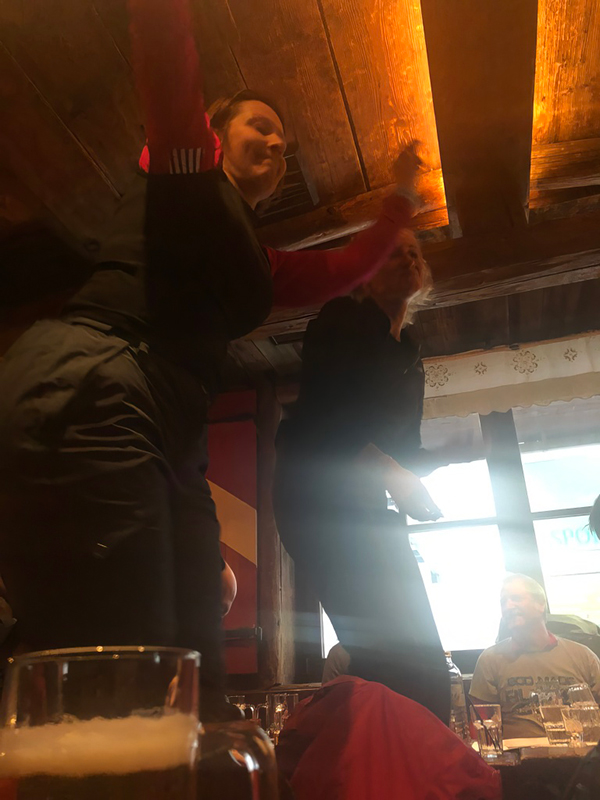
Dancing on the tables is a right of passage in Ischgl
At Galfeisweg 3, near the Pardatschgratbahn valley station, Kitzloch occupies a complicated place in Ischgl folklore. Resident DJ Boris plays every known après-ski hit to a packed crowd from 3pm until 7pm, when the venue transforms into an upscale restaurant which I love for its’ spare ribs.
In March 2020 the bar was the epicentre of a COVID-19 superspreader event that infected over 6,000 skiers from 45 countries – the whole resort quarantined on March 13th and ended the ski season the next day. Just three years on Ischgl had fully recovered and the 2022/23 season recorded 2.2 million overnight stays… and Kitzloch remains as popular as ever, despite the expensive beer.
Niki’s Stadl
Founded in 1989 by the legendary Niki Ganahl (who passed away in August 2015 after earning 10 gold CDs for his après-ski recordings), Niki’s Stadl at Dorfstraße 16 trades on authentic Tyrolean atmosphere. The intimate, rustic interior attracts a loyal following, though regulars note the venue has lost some spark since Niki’s death. “Red Niki’s Stadl hearts” – tokens of appreciation – are still given to favoured guests.
DJ “Jägermeister Alex” plays Schlager hits and prices area a bit more reasonable than Niki’s and for me it’s a bit of old-school Ischgl.
Fire & Ice
Next door to Kuhstall on Dorfstraße, Fire & Ice is aimed at a young and trendier crowd with a modern interior taht includes a pole-dance bar (open to all, regardless of skill level or gender), and a quieter lounge upstairs. Open until 2am Sunday to Tuesday, 3am Wednesday to Saturday.
Freeride
Freeride is near the Pardatschgrat elevator and is a slightly less hectic alternative to Schatzi Bar, with female dancers from 4pm. Locals sometimes call it “Schatzi from the Aldi” which is unfair but does give you a sense of where it sits in the pecking order. Beer costs around €8 for 0.4L. Growing in popularity year on year.
Wedl Alm
A newer bar between Niki’s Stadl and Kitzloch, Wedl Alm has modern interiors and ambitious champagne collection but also affordable beer. I recommend the burgers
Hexenküche or Witch’s Kitchen
Near Kuhstall Witch’s Kitchen is the quieter option and where conversation is possible. No dancing girls or table dancing, just drinks and atmosphere.
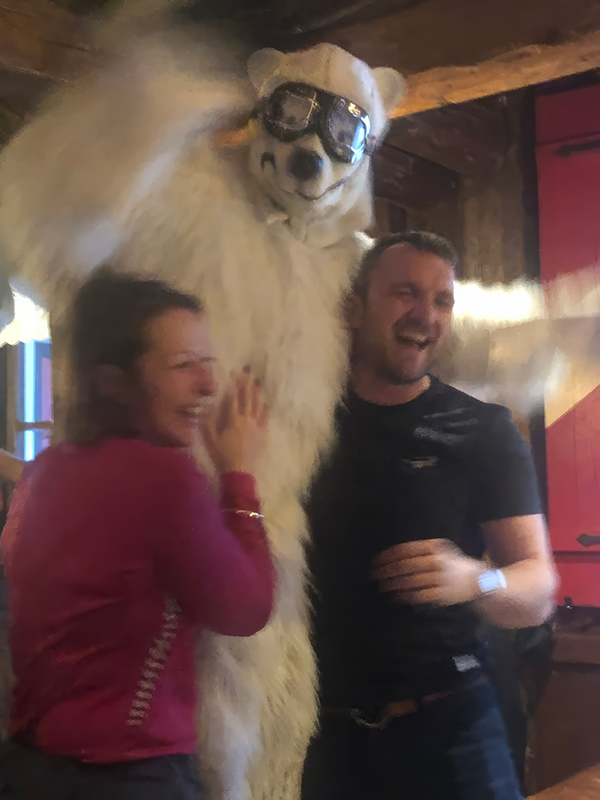
You haven’t partied in Ischgl until you’ve partied with a polar bear
Best Early Evening Bars in Ischgl
Golden Eagle Pub
If the noise and chaos become too much, Golden Eagle at Kirchenweg 19 is a regular Irish-style pub with no loud music and no dancing. I like the cheaper Belgian beer (Westmalle and Chimay etc) and easy-going atmos where you can have a conversation.
Champagnerhütte
At Dorfstraße 85 in the Schlosshotel Romantica Ischgl’s champagne-and-oysters set congregate. With Dom Pérignon at nearly €400 a bottle this isn’t a budget option but for sophisticated drinks in elegant surroundings, the Champagnerhütte and associated Champagne Club deliver.
Guxa
Guxa specialises in cocktails, a walk-in humidor for cigar lovers and impressive whisky selection from 6pm until 2am. Maybe this is where you come when you’ve graduated from shots, but I will likely never know…
Late-Night Clubs Where Ischgl Earns Its “Ibiza” Name
Pacha Ischgl
It’s part of the famous Pacha brand but located inside Hotel Madlein on Madleinweg, Pacha opens from 10pm until 6am daily (top DJs on weekend) and earned a reputation as “where Paris Hilton parties in the Alps.” This club is Ischgl’s premier late-night destination although stretched Hummer limo service is a bit embarrassing.
Trofana Arena & T6
At Dorfstraße 95 near the Silvrettabahn, the Trofana Arena has been Ischgl’s “Pearl of the Alps” since 2003. Live music and laser shows backing the professional table dancers feels like Vegas-in-the-mountains and the New Year’s Eve party really good.
Livingroom
Livingroom inside Hotel Grillalm at Dorfstraße 97 has a modern design open 9pm to 6am but I’ve never been in so can’t really recommend it (maybe have a go if you don’t like Pacha and let me know if the comments).
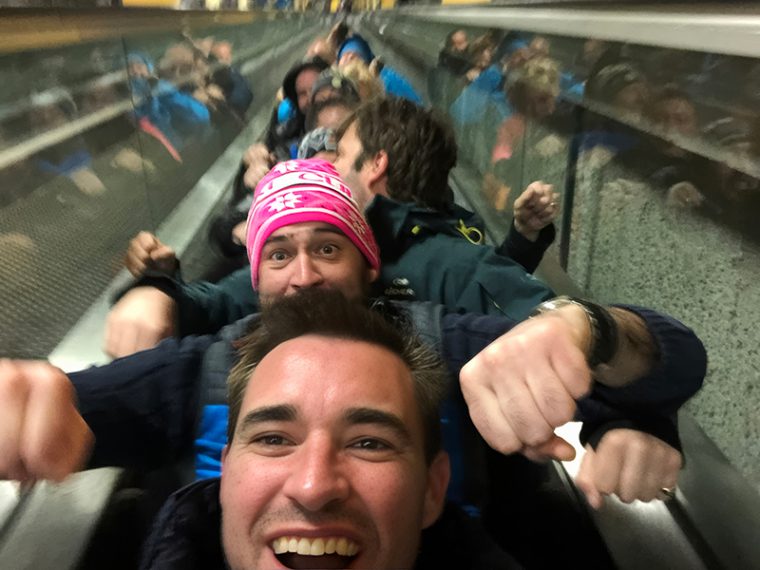
It now traditional for SNOman and pals to “row” through the mountain on the Ischgl travellator
When I take a newbie around Ischgl, this is roughly how I structure the après ski and evening:
1:30pm ski to Paznauner Taja to start the mountain après, but one or two drinks max, as we still need to ski down.
3:30pm arrive at either Schatzi Bar if you want the full dancing-girls experience or Trofana Alm for a classier or maybe just more expensive party atmos’.
6pm-7pm head back to your digs to shower and change and try to hydrate if you’ve been on the shots at altitude.
8pm-10pm dinner is also recovery as the village bars quieten temporarily while people eat.
10:30pm onwards if you’re continuing rather than getting to bed ready for first lifts, Trofana Alm or Kuhstall shift into nightclub mode or we can head straight to Pacha.
Midnight-4am late night is best at Pacha or Trofana Arena if we have the stamina.
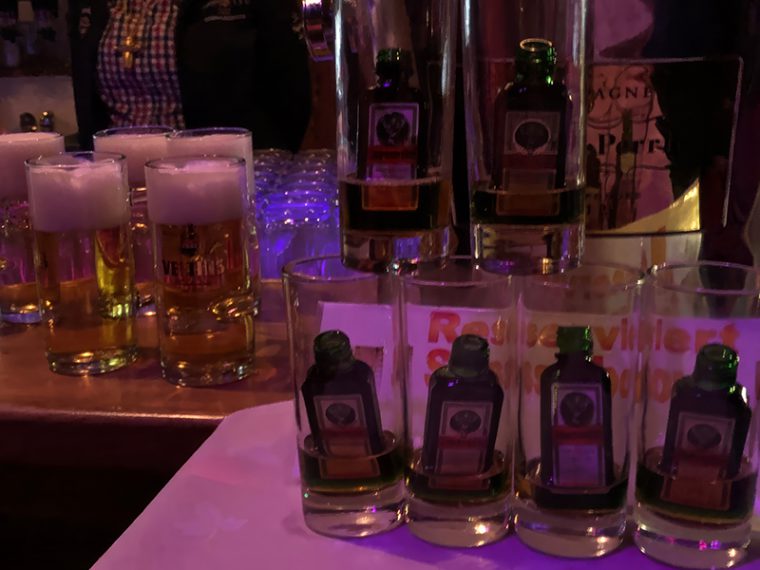
All the après essentials – beer and Jaeger bombs
Ischgl Top of the Mountain Concerts Are The World’s Highest Music Festival
Since Elton John inaugurated it in 1994, four times each season Ischgl transforms the 2,320m Idalp plateau into an open-air concert hosting some really big international stars.
The four annual concerts:
Opening Concert – Late November, kicks off the season
Easter Concert – Easter Sunday
Spring Concert – Mid-April during the Spring Blanc festival
Closing Concert – Early May, finale of the season
Confirmed performers for 2025/26:
Rita Ora (November 29, 2025 – Opening was AMAZING)
Ben Zucker (April 19, 2026 – Spring)
Christina Aguilera (May 2, 2026 – Closing)
Previous headliners have included Robbie Williams (who famously performed through a snowstorm in 2014), Rihanna, Tina Turner, Bob Dylan, Lionel Richie, Katy Perry (in a Santa costume, 2009), Lenny Kravitz, Pink, Alicia Keys, Black Eyed Peas, James Blunt, Muse, Rod Stewart, Bon Jovi, and Mariah Carey.
How do the Ischgl mountain-concert tickets work? Your ski pass is your concert ticket. A day pass costs €95 for adults, €60 for under-17s (free for under-8s with an adult). Multi-day pass holders get the concerts included at no extra cost. The concerts are accessible via the main cable cars (Silvrettabahn, Fimbabahn, Pardatschgratbahn) even without ski equipment.
Drink prices: Budget €7-9.50 per beer depending on venue. Kitzloch is the priciest (€9.50/0.4L); Golden Eagle is better value with 0.5L only €6.
Transport: The village is pretty compact and walkable and a free ski bus connects Ischgl with neighbouring Galtür, Kappl, See, and Mathon if you’re staying outside the main village, or try Alpentaxi +43 5444 5757 if you get stuck.
Best nights are weekends as they’re are busiest but unlike quieter resorts Ischgl is lively throughout the week if you stick to my main recommendations.
The girls show us how apres ski is done in Ischgl
How Ischgl Compares to other Après Ski Greats
SNO clients often ask whether Ischgl or St Anton après ski is the better and the honest answer is that the resorts offer different experiences.
St Anton après ski probably wins for raw, slopeside chaos because the Mooserwirt and Krazy Kanguruh deliver peak après ski madness between 3:30pm and 8pm, with dancing on tables in ski boots and a gloriously unpretentious atmosphere. If ski-boots-on, sunshine-soaked afternoon drinking is your priority I would have to say that St Anton edges ahead but…
Ischgl wins for late-night options and overall polish because once the slopeside bars close in St Anton, the evening options thin out more. Ischgl is busier until 4am or later, with proper nightclubs and the Top of the Mountain concerts also give Ischgl something St Anton can’t match.
Honestly I love both and would probably recommend Ischgl for a slightly tonier après ski experience which is more fully enjoyed if your budget is not tight.
I’ve skied most of the major Alps party resorts (St Anton, Val d’Isère, Verbier, Val Thorens) and Ischgl remains one of my absolute faves. Is it for everyone? Well not if want quiet mountain restaurants and early nights, but if the prospect of dancing in ski boots to German Schlager works, watching/joining go-go dancers then continuing until 4am alongside Paris Hilton sounds like your kind of ski holiday… I have to recommend Ischgl.
Mount Everest is the world’s tallest mountain, standing at a colossal 8,848 m. It straddles the border between Nepal and Tibet, set in the Himalayan range. This mountain is a brutal force of nature, dispersed with giant ice walls, hidden crevasses, deadly avalanches, and extreme altitudes that will dull your senses. Still, nothing will compare with the feeling of reaching the summit and being on top of the world.
A few brave adventurers will challenge themselves with the ferocious ascend to the summit, very few attempt to ski back. With it being double the height of the Matterhorn – one of the largest mountains in the Alps, skiing down Mount Everest would be the ultimate challenge. With the barren conditions commonly found on Everest summit, is it possible to descend this mammoth mountain on a pair of skis?
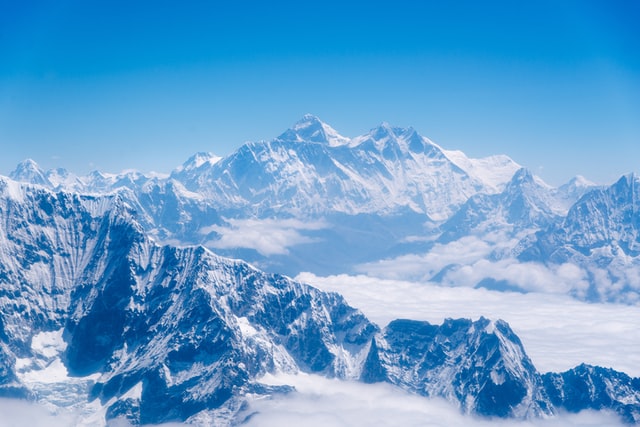
Mount Everest is a mountain on the crest of the Himalayas
Everest ski facts
Height- 8848m / 29,016 ft
Wind speeds get up to 200 mph
Temperatures can reach -80 F
Mount Everest grows 40cm per century
July is the snowiest month on Mount Everest- Averaging 6.8 snow days per week
It is capped with snow and ice all year long- from 5800 m
May – June is the best time to ski Mount Everest- Warmer and less windy
Can you ski on Mount Everest?
Technically, it is possible to ski down from the summit of Everest. A few trailblazers have taken on this epic descent and succeeded. Naturally, skiing down Mount Everest could not be achieved without significant difficulties.
Has anyone skied Mount Everest?
Yes, so far three ski mountaineers have successfully skied specific or named “first descents” down Mount Everest.
Yuichiro Miura
A Japanese alpine skier called Yuichiro Miura attempted his descent in 1970. He was famously known as ‘the man who skied down Everest,’ the title of the gripping Oscar-winning film documenting his journey on Everest. Encore captured his extreme descent from the south Col section of Everest at 8082 m, surrounded by nothing but sheer ice. In an attempt to control his speed, Miura opted to deploy a parachute. The summit, considered the most desolate place on earth, a strong galeforce and combined thin air was not favourable conditions for a parachute and proved ineffective. Miura, off-balance, fell helplessly down towards a vast crevasse, an unfathomed canopy of ice that cut across the face of the mountain. Close call, but fortunately, he came to a stop and completed his bumpy 4,200 ft vertical descent in 140 seconds, down to 6200 m.
Davo Karnicar
Davo Karnicar, a Slovenian extreme alpine skier, took it a step further. Karnicar embarked on Everest’s south face in 2000, after a failed attempt on the north face four years earlier, resulting in losing his index and little finger to frostbite. Back stronger, Karnicar streamed his descend live via a webcam on his helmet to over 4 million people, which helped fund the 70,000 USD for his permit. Karnicar accomplished his goal to be the first person to ski down from the summit to the base camp without removing his skis. He descended over 3500 m in 4 hours and 40 minutes, an extraordinary feat that will be difficult to repeat.
Andrzej Bargiel
A polish skier, Andrzej Bargiel, had sights firmly set on conquering Everest and the ambition to surpass Davos Karnicar’s accomplishment. Skiing down from the summit without oxygen assistance is a feat that has not been attempted, let alone achieved. His first attempt was aborted in September 2019 due to a dangerous hanging block of ice; he retried in the autumn of 2022 but cancelled this attempt due to dangerous weather conditions. Bargiel has a solid track record of high altitude skiing, impressively becoming the first man to descend the 6811 m tall K2 peak. The pilgrimage was described as immensely treacherous, rocky, with patchy snow. But he remarkably managed the whole descent without removing his skis. He set off to Everest in August 2025 on his third attempt, still hoping to be the first skier to descend from the summit without oxygen.
Update 27/09/2025:
On Friday 26th September 2025 Andrzej Bargiel succeeded in being the first human to ski down Mount Everest without supplemental oxygen, after spending 16 hours in the death zone to summit the world’s tallest mountain, and 2 days to ski down. SNOman of top UK ski travel provider SNO Ski Holidays sent congratulations Andrzej saying, “I cannot express how awed we all are here at SNO Ski – you are superhuman Andrzej!”
“It’s one of the most important milestones in my sports career,” said Bargiel.
After skiing down to Camp 2 before night fell, Andrzej continued the following morning to ski down to base camp, all with the help of his brother sighting ahead of him for safety, remotely with a drone. “I knew that the difficult autumn conditions and plotting the descent line through the Khumbu Glacier would be the greatest challenge I could ever face.”
The exhausted but jubilant ski mountaineer described this feat as the pinnacle of his alpinism career, “skiing down Everest without oxygen was a dream that had been growing inside me for years.”
St Anton am Arlberg has earned its crown as the world capital of après ski through a century of Alpine tradition legendary venues and an atmosphere that transforms skiers and snowboarders into rabid partygoers when the infamous 3:30pm countdown begins. Over the years I’ve spent countless weeks “researching” every watering hole on your behalf from the mayhem of the Mooserwirt to the sophisticated wine cellars of Hospiz Alm. I can confirm that no other resort matches the St Anton combo’ of authentic Austrian culture and international energy but it’s always horses-for-courses so read-on to gauge which venues best match your own predilections and peccadillos.
Snoman’s ski buddies inside the legendary Mooserwirt
Why St Anton’s Après Ski Reigns Supreme
Is St Anton the Birthplace of Modern Skiing Culture?
It’s important to understand that St Anton isn’t just another Alpine resort with bars on the mountain. This is where Hannes Schneider founded the world’s first ski school in 1922 and where the Arlberg technique revolutionized skiing, and where après ski evolved from simple post-skiing refreshment into a cultural phenomenon that now defines yours and my Alpine winters. The resort’s 45 venues across six interconnected villages create an après ski atmosphere unmatched anywhere in the Alps.
The Ski Resort Transforms at 3:30pm Each Day
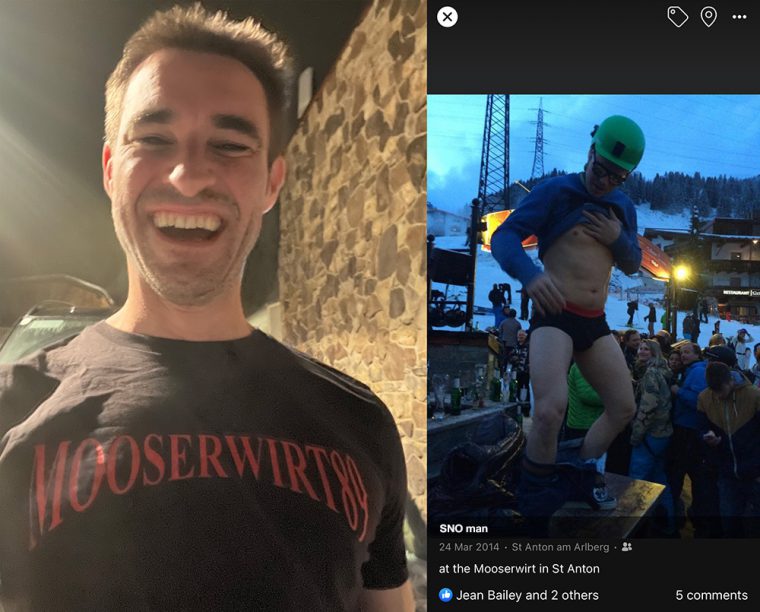
At precisely 3:30pm like clockwork something remarkable happens across St Anton’s mountains and for me it starts with the Mooserwirt. The blinds drop and Europe’s “The Final Countdown” strikes up as thousands of skiers transform into party-goers. It’s a ritual that’s run uninterrupted since 1989 (see in the pic that I’ve literally been there and got the T-shirt), turning what could be just another mountain bar into a cultural institution. The energy is infectious and within minutes our ski boots are stomping on tables with strangers sharing shots of Jägermeister, and the atmosphere reaches levels that make you understand why Mooserwirt reputedly sells more beer per square meter than any other bar in Austria.
I managed to swap T-shirts with a barmaid after table dancing with an Olympic hockey team (long story)
The Mooserwirt is The Greatest Apres Ski Bar in the World
Location: Mooserweg, accessible via blue run from Gampen/Galzig Hours: Closes 8pm daily (peak party 3:30-6pm) Prices: Beer €8+, Jägerbomb €9-14
Mooserwirt’s ironic tagline “Probably the worst ski hut in the Arlberg” belies its significance as one of the two great après ski meccas (the other being the original Folie Douce in Val d’Isere). DJ Gerhard is now 72 and has been spinning the decks here since 1994 and orchestrating controlled chaos that peaks when those blinds drop (he now shares sets with son Thomas as the torch is passed down to the next generation). The table dancing that follows operates on the unwritten rules of waiting for the energy to peak and then helping others up to share tabletop space generously. To experience the full-welly I think the trick is good timing because arriving before 3pm might still score you a table. I recommend buying your first round of shots at the same time as your first round of beers because those who look as green as the Jaeger bottles can quickly wash down the acrid taste.
Krazy Kanguruh is the Après Dance Party Original
Location: Before Mooserwirt when skiing into town, on Mooserweg Hours: Closes 8pm (sun terrace party from 2pm) Prices: Similar to Mooserwirt but cheaper happy hour deals
Krazy Kanguruh is owned by Olympic champion Mario Matt and claims the title of “the original home of après ski” (operating since 1965). The massive sun terrace transforms into what locals accurately call “Arlberg’s largest open-air dance floor” and the music leans more rock and house than pure schlager as it attracts a slightly younger crowd. Their Australian Day celebrations (Jan 26th) are legendary with the entire terrace draped in Aussie flags and Foster’s replacing the usual Austrian beer selection.
Taps is Literally a Happy Middle Ground
Location: Between Mooserwirt and Krazy Kanguruh Opens: 10am-8pm Happy Hour: 3:30-4:30pm (crucial for budget-conscious partying)
Taps is a bit of a breathing space between its intense neighbours. It’s popular with seasonaires and features some of the best mountain views and (crucially for the SNO team) the area’s most reasonable prices during happy hour. The atmosphere is festive without being overwhelming so I recommend Taps if your group has a bit of a mixed tolerance/appetite for partying.
Basecamp is St Anton Stab at New School Après with a Bit of Sophistication
Location: Gampen chairlift base Opens: 9am-8pm Prices: Most expensive on mountain (€8+ for 500ml beer)
Basecamp represents modern day St Anton sophistication but it’s still pretty wild. The live saxophonist plus premium burgers and extensive wine list attracts a slightly more grown-up crowd but the staff actively encourage dancing on the bar from around 4pm. Despite the higher prices it remains packed thanks to terrific food and a somewhat more refined party atmos’.
Sennhütte Embodies the Traditional Austrian Soul of After-Ski
Location: Above St Anton via Sennhütte drag lift Opens: 10am-midnight Speciality: Homemade schnapps, traditional music
I recommend Senhutte if you like authentic Tyrolean après ski away from the tourist masses. The homemade brandies are really tasty and the accordion music is genuine but the ribs are my main reason for visiting. Reaching it requires a bit more effort as the drag lift isn’t easy after a few drinks but that’s probably what keeps the crowds manageable.
Piccadilly Bar has live music from 9pm nightly with resident performer Andy Joseph and the upstairs is a good spot for people-watching over Dorfstraße.
Postkeller is their basement nightclub which opens at 10pm and gets liveliest after midnight until 4am but that won’t help you get on the first lift!
Murrmel has the Best Atmosphere between Après and a Night Out
Location: Dorfstraße Star Attraction: Gunnar performs 5pm daily except Wednesday/Sunday Food: Gourmet burgers until late
When Gunnar takes the stage Murrmel transforms the vibe with his amazing energy. He’s the rresident performer and has been creating magic for eight years, turning what could be another village bar into St Anton’s best atmosphere which for me perfectly bridges après ski and nightlife.
Kandahar if You Like to Dance Until Sunrise
Location: Lower Dorfstraße Opens: 8pm-6am Unique Feature: Thai/Indian kitchen open until 4am
They claim it’s been voted “best nightclub in the Alps” but when pressed couldn’t say by who (tried not to laugh) but in truth the Kandahar is probably the best disco in town. I recommend the spicy and authentic Asian cuisine which seems a bit incongruous with a harcore nightclub but it’s pretty awesome to have a curry at 4am!
My St Anton Bar/Club “Hidden Gems”
Griabli is probably St Anton’s “best-kept secret” because it’s dedicated to rock music which is my preference and rare in the Alps with live bands every Tuesday from January to March.
Bobos has good Mexican food and cocktails 5pm-3am which is a safer combo (some food with your drinks).
Underground Den has live rock bands nightly and a proper pub atmosphere and good steaks.
Scotty’s Bar can save you a few bob with 2-for-1 cocktails 10pm-midnight (it’s in a small basement under hotel Rosanna) and I like it because it’s a favourite of local seasonaires (you might struggle to sneak in on “Worker’s Wednesdays” but it’s with the effort.
Snoman and buddies exit Mooserwirt to slide down the piste on our jackets
What Venues Outside St Anton Are Worth the Journey?
St Christoph’s Famous Hospiz Alm is My Top Recommendation
The Experience: Michelin Guide restaurant meets party venue Famous For: 7,000+ bottle Bordeaux collection, concrete slide down to toilets Prices: €40-70 for three-course dinner
Hospiz Alm defies categorization but I can honestly say it’s one of my favourite places to eat in all of the Alps. What looks like a traditional ski hut is in fact a gourmet temple with a wine collection (focusing on large-format Bordeaux) that’s been called “museum-quality”. The famous slide down to the basement toilets is an attraction itself and the photos of Michael Schumacher, Putin and Tony Blair give you an idea of how top-drawer its legendary restaurant is. It’s not cheap but I recommend dinner here if you want to experience how upscale fine dining meets Alpine life (you don’t need.
Lech is the More Sophisticated Sister to St Anton
Journey Time is about 25 minutes by bus/taxi (€79 daytime taxi but more at night)
Schneggarei is basically Lech’s answer to Mooserwirt but with better pizza and wine and I think rated #1 on TripAdvisor for good reason.
Ice Bar at Tannbergerhof has a heated lounge area plus umbrella bar and a VIP balcony for sophisticated partying Lech-style.
K.Club is considered by some to be the most exclusive address in the Arlberg and is hidden in Hotel Krone.
Quieter Alternatives Near to St Anton
Stuben’s Fuxbau has a chic Alpine interior and incredible sunset views alongside a more calm sophistication.
Zürs’s Zürserl is not all about Champagne and fur coats but is still focussed on catering to the luxury market.
The Art of St Anton Après Ski
Money-Saving Tips For Partying in St Anton
St Anton ranks as Europe’s second-most expensive resort for après ski (€39.70 for five drinks). Survival tactics:
Eat substantial mountain lunch (11am-2pm) before drinking
Hit happy hours religiously (Taps 3:30-4:30pm saves 30%)
Group bottle service often beats individual drinks
Scotty’s 2-for-1 cocktails (10pm-midnight) for late nights
Bring cash – mountain venues rarely accept cards
Transportation After the Free Bus Ends
The free ski bus stops at 5:30pm and then you have these three options:
Walking is the main approach but it can be a bit treacherous when icy/drunk
Night bus “James” is a one-off €8 per night and runs 8pm-2am
Taxis start at about €15 from Nasserein to center which is handy for upper Nasserein
Remember that night buses don’t reach upper Nasserein so make sure you can still walk!
Safety First
Altitude affects your alcohol tolerance so try to limit consumption the first 48 hours
Arlberg Safety Card (€15-25) covers rescue costs and might be worth considering
Emergency numbers +43 5446 2352 223 is for accidents before 5pm but emergency is 112
Health advice hotline: is also meant to be available 24/7 by calling 1450
Never ski drunk after 3:30pm (at all?) just take the gondola down and live to ski another day
Schlager Music Is BIG In St Anton
Schlager music – those nonsensical German party songs – provides St Anton’s soundtrack. You don’t need to understand or translate “Wie heisst die Mutter von Niki Lauda? Mama Lauda!” to feel the infectious energy and embrace it.
What are the Rules of Table Dancing?
Wait for peak energy before climbing up (two jaeger bombs will do it)
Always help others up onto the table to join you
Stomp your ski boots (to the beat if you can)
Share the table space generously
Never try this at restaurants or calm venues
What is the Dress Code or Do You Get Changed for Après ski?
Afternoons the proper version should be danced in ski boots (mandatory for authentic experience) Evenings are more nightlife than après and so regular shoes required after 8pm in most venues Trend Alert if you want to make more effort – vintage ‘70s ski suits are having a moment
This is a mass-start race where 555 participants simultaneously racing down unprepared slopes from Valluga Ridge and the après ski that ensues is as frantic (and dangerous?) as the race itself.
What is New Year’s Eve like in St Anton?
“St Anton Illuminated” creates eco-friendly laser shows while every venue hosts special events to make New Year’s special but you need to book your holiday accommodation early as it’s incredibly popular.
Is St Anton Good at the End of Season (late April)?
Yes I love St Anton in April because all rules relax as snow melts and the parties reach crescendos rarely matched during peak season. Late snowfalls can give terrific skiing but I would say you’re more guaranteed great après than skiing after Easter.
Where To Stay In St Anton For The Best Nightlife
Party Central is probably Hotel Post which sits above Postkeller (literally crawl home at 4am) The Best Balance is to stay near Dorfstraße for good access to the action but manageable noise A Peaceful Option would be Nasserein which is a quiet 10 minutes from action and a great base for beginners because the main nursery slopes and ski school meeting points are there I would avoid staying out of town if the nightlife is important to you because you might spend more on taxis
The famous venues get utterly rammed when the weather comes in so check these alternatives:
Rendl Beach is a self-service with spectacular views (if not foggy) and less crowded
Cuba Sports Bar in the valley is a nice little spot to chill with sports screens
Arlberg WellCom has pools saunas ice skating but no drinking (if it’s a total whiteout)
What Is The Perfect St Anton Après Ski Day?
You must stick exactly to my itinerary without deviation or improvisation as I will be checking:
2:00pm start your final run quite early to position yourself near Mooserwirt/Krazy Kanguruh 2:30pm have a light lunch at Sennhütte or quick bite at Taps 3:00pm begin with Jaegerbomb and beer in time to experience the Mooserwirt countdown at 3:30 4:00pm to tick another box move to Krazy Kanguruh terrace for sunset or after sunset at the Moose 6:30pm it’s not smart to descend after dark but at least it’s before the crowds (30min to change) 7:00pm dinner at Underground for live music or Bobos which stays open late 9:00pm I like to liven the evening up at Piccadilly for Andy Joseph’s performance 11:00pm don’t leave it too late to get into Postkeller and start the proper night’s clubbing 2:00am is a stagger to Kandahar where I like to take the survivors, the brave and the foolhardy
Does St Anton Have The Best Après Ski In The World?
Yes St Anton has the best après ski scene in the world, not just for being the wildest but also because it isn’t manufactured but a local cultural evolved over a century. From the daily 3:30pm ritual at Mooserwirt to 6am closings at Kandahar, from traditional Tyrolean Sennhütte to exclusive K.Club in Lech, no resort matches this variety and authenticity.
Can Beginners Really Master the Legendary Arlberg?
After decades of watching nervous beginners transform into confident skiers on St Anton’s slopes, I can definitively answer the question that brings you here: YES, beginners can thrive in St Anton – but only if you know the what/where/why/how of learning to ski in incredible town.
SNO mates learning with St Anton ski instructor
St Anton carries a fearsome reputation because it’s “the home of hardcore” where Hannes Schneider invented modern skiing technique in 1922. It’s where Olympic champions train and the notorious Valluga attracts extreme skiers from around the globe. Walk into any mountain bar and you’ll hear tales of cliff drops, couloirs, and knee-deep powder days that would definitely put off a beginner and likely terrify them.
Yet every season I see thousands of complete beginners successfully learn to ski here and many progress faster than they would at supposedly “easier” resorts. For me the secret is that St Anton has three dedicated beginner zones that operate almost independently from the challenging terrain that built the resort’s reputation. Even more importantly I think the quality of instruction here (in the cradle of Alpine skiing) can accelerate your learning curve quite a lot.
The bare stats are a bit misleading because St Anton has just 35% blue runs compared to 43% red and 22% black but those beginner areas are purpose-built for learning because they’re protected from weather and staffed by instructors who’ve inherited a century of teaching excellence. I genuinely believe that when you master the basics here it gives you a technical foundation that serves you wherever you ski next.
The Honest Truth – Is St Anton Really for Beginners?
St Anton is not a typical beginner resort and some of the blues here can feel like reds elsewhere, the weather can be harsh and yes the infamous Steissbachtal home run (number 50) can get choppy by the afternoon. But I think St Anton usually works brilliantly for beginners because the instructors (this is where modern skiing was born, and the teaching methodology refined over a century) have three distinct beginner areas (Nasserein, Gampen, and Rendl), you’re not confined to one small nursery slope. Beginners can buy a 60% discounted lift pass which does save a lot.
Who Should Consider St Anton?
We recommend St Anton to mixed-ability groups where beginners want world-class instruction while advanced skiers explore the vast terrain. It also really appeals to holiday makers looking for authentic Austrian Alpine culture rather than purpose-built and more artificial ski resorts. When you’ve gone past beginner’s level and have ambitions to ski at a higher level, the quality of instruction is terrific but not cheap (group lessons start at €140 per day).
Who Should Look Elsewhere?
A complete beginner on super-tight budget will find it cheaper to learn to ski in smaller and less famous resorts like Bansko or Livigno. Families with young children should consider Lech just 20 minutes away which is known as a posher but smaller town which still has lots of beginner terrain. If you want tons of easy blue runs for cruising and ski-in / ski-out chalet or hotel for convenience, I would steer you towards one of the French mega resorts like Val Thorens or Tignes.
The Three St Anton Areas Where Beginners Learn To Ski
Nasserein is the Beginners’ HQ
Located on the eastern side of St Anton, Nasserein operates as an independent beginner sanctuary which is accessed via the Nassereinbahn Gondola and has a dedicated ski school meeting point at the base station. The village of Nasserein itself is barely a 10 minute walk from St Anton centre and has a quieter accommodation options.
I think the standout run is number 31 which is a tree-lined blue with natural protection from wind and good visibility when clouds descend on the higher peaks. The gradient is consistent and gentle which makes it ideal for building confidence. At the base magic carpets (free with ski school) help complete beginners to find their ski legs without the stress of learning to get on a chair or drag lift. The Übungslift Nasserein is a simple button lift which serves as the next step on your journey.
Gampen is the Sunny Practice Area
Gampen connects to Nasserein via the Galzig gondola and has warmer south-facing slopes that catch afternoon sun which is a blessing for debutantes during cold January weeks. The area’s signature beginner run is Hopplweg (number 27) quite cutely themed around “Hoppl the bunny” with fun features for children but equally suitable for adult beginners.
I like this area because newbies can link runs 27, 31, and 50 into the Plattiwald trail, but I suggest you should avoid the lower section of run 50 after lunch when it can get a bit chopped up with moguls. The wide-open terrain at Gampen gives you a lot of space to practice turns (beginners can feel a bit hemmed-in on narrower trails).
Rodelalm restaurant is a nice spot for a slope-side lunch with traditional Tyrolean cuisine and pretty reasonable prices.
Rendl is a slightly Quieter Alternative
Rendl operates basically as a separate mountain accessed via the Rendlbahn gondola from St Anton’s western edge. This separation does tend to mean fewer crowds and a more relaxed atmos’ and I think the beginner runs (numbers 9, 11, 13, 14, and 15) are really gentle although quite short.
The main limitation is that only red runs return to the valley, so beginners must be careful to download via gondola at day’s end. I don’t think this is necessarily negative because it removes the pressure of attempting a difficult home run when you’re tired. The “Rendl Beach” area has a gorgeous sun terrace and the north-facing slopes hold good snow conditions later in the season.
My Day-by-Day Guide Your First Week Learning in St Anton
Day 1 is about Finding Your Feet
An early morning equipment fitting at Intersport Arlberg in Nasserein saves precious slope time and you should try to arrive at the Nasserein ski school meeting point 15 minutes early because your instructor and the rest of your group won’t want to wait. Your first hours will focus on basic balance and movement on a pretty flat area and then move on to gentle slopes via the magic carpet. If you crack the basic snowplough before lunch the afternoon is for practicing on your own (unless you booked all day lessons) but you also deserve a rest (I recommend the Arlberg WellCom spa’s heated outdoor pool).
Day 2 is for Learning Your First Turns
Today your coach will introduce the Übungslift button lift and your first real turns. The snowplough position will still feel unnatural at first but St Anton’s instructors break down so you’ll soon get it. Hopefully you’ll manage some controlled descents by the afternoon.
Day 3 You’ll start to Building Confidence
Your instructor might introduce run 31 today which is a tree-lined blue that can become your training ground for the week or as long as you need. I’ve found that if novices focus on controlling speed through turning (instead of constant snowploughing) you tend to get better quicker.
Day 4 means Exploring the Gampen Area
The Galzig gondola takes you much higher for your first taste of “proper” mountain skiing up at Hopplweg (run 27) which is slightly longer than your nursery runs but still a comfortable gradient.
Day 5 try a bigger Adventure in the Rendl Area
A morning excursion to Rendl exposes you to different snow conditions and quieter slopes. Runs 9, 11, and 13 give you more variety of slopes without being too challenging and the panoramic views from Rendl Beach during lunch are stunning. Remember to download via gondola because attempting the red runs could be a bit dangerous so soon or at least knock your confidence.
Day 6 working on Linking Turns
This day is usually without your instructor so I advise you return to whichever area suited you best and just keep working on linking turns rhythmically, maintaining consistent speed, looking ahead rather than at your skis. Advanced beginners might want to try the full Plattiwald trail (not the bottom of run 50).
Remember to celebrate at least one afternoon at my favourite apres ski bar (and voted by many as best in the world) the Mooserwirt, where DJ Gerhard has been spinning the wheels of steel since I first danced on a table there almost three decades ago!
Which are the Best Beginner Ski Schools in St Anton?
Skischule Arlberg is the O.G.
Founded in 1921 by the legendary Hannes Schneider Skischule Arlberg is more than a mere a ski school because it’s the birthplace of modern skiing technique. It has almost 300 local instructors depending on season and claims (quite credibly I think) to be the Alps’ largest and most prestigious ski school.
Your coach’s meeting points vary by level:
Beginners at Nassereinergasse 8 (don’t go to the main office)
Main office is at Kandaharweg 15 (near Galzigbahn)
St. Christoph is their alternative quieter location
2025/26 Pricing:
Group lessons: €110 to €123 per day for adult beginners
5-day packages from €324 to €360 depending on dates
Private 2-hour lesson from €303 in the morning or afternoon
Full-day private from €591 for 6 hours
Alternative Options
Ski School New Generation has British instructors at competitive rates and we’ve had nothing but good feedback from our clients who’ve learne with them. Group lessons start from €300 per week and I reckon they’re particularly good for nervous English-speaking beginners who prefer instruction in their native language.
St Anton ski instructor demonstrates for our beginners
Staying in Nasserein puts you within 150 meters of the nursery slopes and eliminates morning transport faff. Mainly I like it for the family-friendly atmosphere and it’s still barely a 10-minute walk from St Anton’s nightlife. This village area has some really good value hotels and apartments available through SNO that provide really quick access to the beginner slopes.
The top advantage for me is that you can walk to the ski school meeting point in your ski boots, return for lunch or clothing if needed, and avoid the morning rush for lockers in the main village. All our properties in this area offer ski storage for your skis and boots and many include wellness areas for post-skiing muscle soak or massage!
St Anton Center is Best For Mixed Groups
Central St Anton suits mixed-ability groups who want evening dining and entertainment options, but you’ll need to walk or shuttle to beginner areas each morning. You’re at the heart of the resort’s famous atmosphere and we’ve lots of centrally-located properties that balance being bear nightlife plus proximity to beginner transport links.
Ask our friendly experts about accommodation near the Galzigbahn for easiest access to the beginner areas and properties which include a shuttle services to the slopes. Many central hotels provide a free ski bus that stops at Nasserein too.
St. Christoph is a Much Quieter Alternative
Located above St Anton at 1,800m, St. Christoph is all about snow-sure accommodation with pretty much immediate access to gentle slopes. While limited in dining options, it’s perfect for beginners and anyone who prioritises skiing over nightlife. The morning ski school groups here tend to be smaller so you might feel you’re getting more personalised attention.
Budget Considerations
Early December and late April can get you 30% discounts on most accommodation. For best value it’s best to book packages that include accommodation and flights/transfers together because you also get ATOL protection. SNO’s group booking service can secure additional discounts for parties of 10 or more.
What Equipment Do I Need to Hire?
Our team will help you sort out ski and boot rental when you book your holiday but I would recommend these in the Nasserein area if sorting it out yourself:
Intersport Arlberg – Dorfstraße 1 has the largest gear selection
Check In Nasserein – Nassereinergasse 8 is handy for the ski school meeting point
2025/26 Ski Rental Pricing
Economy skis from €19/day
Helmet around €35/week (essential for beginners but I would buy one)
Ask our team if there are any equipment rental discounts, as there often are.
Equipment Tips for Beginners
Ski length should reach between chin and nose but beginners should pick shorter skis for easier turns. Boots should feel snug but not painful and your toes should brush the front when standing upright but pull back when you flex forward. Don’t accept boots that cause pain becahse they’re sold plastic so they don’t break-in.
Easy-Access Lunch Spots On the Mountain That I Recommend
Gampen Restaurant at the top of the Nasserein gondola claims to have the Arlberg’s largest sundeck and the self-service keeps prices reasonable (€10-18 for a main course).
Rodel Alm is great with €16 spit-roasted chicken and you can ski in via blue run 33 which makes it reachable by day three or four for a new skier. The trad Tyrolean interior has an authentic atmosphere which is nice when weather drives you inside.
Rendl Restaurant has a wide variety with everything from stir-fries to burgers. The self-service keeps lunch quick which I like for maximizing slope time and it’s big so finding seats is rarely a problem.
My Most Recommended “Special Experience” In St Anton
Hospiz Alm in St. Christoph might be skiable by the end of your first week (ask your instructor’s opinion) and is St Anton’s most famous mountain restaurant. The concrete slide down to the loos in the basement is fun and the wine cellar holds 35,000 bottles of the best booze in the Berg. Last time I was in I spotted photos in the entrance of Putin, Micheal Schumacher and Tony Blair among the great and the good!
The beginner lift pass discount makes St Anton surprisingly affordable for novices:
Beginner pass is 60% discount off full price
Includes all practice lifts, magic carpets and Nasserein area
Upgrade to a full pass when you’re ready (pay difference)
2025/26 Full Ski Pass Prices in St Anton
6-day adult is up to €450 (depending on season)
Daily adult is €81.50 full or €46.50 beginner’s
Children (8-15): €49 per day or €25 beginner
Under 8s: €11 flat fee per day
Getting To St Anton
Honestly it’s easiest to book a package ski holiday from your nearest airport, as transfers between the airport and your resort accommodation are included, but doing it all manually yourself is also an option.
From the UK:
Innsbruck Airport: 1.5-hour transfer, most convenient option
Zurich: 3-hour transfer, more flight options
Munich: 3.5-hour transfer, often cheaper flights
Airport Transfers:
Shared shuttle: From €45 per person
Private transfer: From €350 per vehicle
Train: Possible via Innsbruck but complicated with equipment
What’s the rough cost per person of a beginner ski holiday in St Anton?
Indoor Alternative Activities For Bad Weather or a Day Off Skiing
Arlberg WellCom
The sports and wellness centre provides perfect storm-day relief:
Pools: 12:00-22:00 daily
Saunas: 10:00-22:00
Features: Outdoor heated pool, waterslides, children’s area
Entry: €22 adults, discounts with guest card
Arl.Rock Sport Center
The 1,000m² climbing area also has bowling, tennis, and squash and is open 13:00-22:00 daily.
Tobogganing
The 4.2km run from Gampen to Nasserein operates Tuesday and Thursday evenings with floodlights. At €20 for adults without ski pass, it’s an affordable thrill and toboggans rent for €8.
Beyond Skiing: Complete St Anton Experience
Après-Ski Navigation
St Anton’s après-ski reputation needs careful handling for beginners. Start at Taps bar at 3pm for happy hour prices in a controlled environment. The legendary Mooserwirt deserves a visit but you might decide to leave before 4pm when dancing on tables in ski boots becomes dangerous. An afternoon at the Moose with friends is probably my favourite thing in the world but Austrian law mandates that après-ski ends at 8pm, so pace yourself accordingly.
Evening Activities
Horse-drawn sleigh rides cost €100 for up to four people and the ice skating outside WellCom our favourite family-friendly evening entertainment. Several restaurants host traditional Tyrolean evenings with schuhplattler dancing and zither music.
Winter Walking
70km of marked winter trails accommodate non-skiers. The 2.5km village loop takes you past traditional Tyrolean houses and the lovely old parish church, and the 2km walk to St. Christoph follows the old road which has great valley views and no really steep climbs.
St Anton Beginners FAQ
Is St Anton only for experts?
No not at all – St Anton attracts expert skiers but the three big beginner areas will keep learners skiing all week. I actually think the resort’s hardcore reputation benefits beginners by reducing crowds on the easier slopes.
Is learning to ski in St Anton expensive?
St Anton costs less than Courchevel, Val d’Isère, or Zermatt and the beginner lift pass discount plus free under-8 passes and self-service mountain restaurants help control costs. Equipment rental and lessons are similar to other major Alpine resorts.
Are the blues in St Anton too difficult?
No generally they are the correcet level but some blues, particularly the lower section of run 50, do become challenging. Stick to my recommended runs (31, 27, 9-15 on Rendl) and your instructor will guide sensibly too.
Is there too much partying in St Anton
Not at all because the Nasserein and St. Christoph are peaceful alternative places to stay outside central St Anton and après-ski legally ends at 8pm, so evenings are actually quite civilized compared to some resorts.
Is St Anton suitable for complete beginners?
Yes St Anton can work well for complete beginners if you use the dedicated learning areas in Nasserein, Rendl and Gampen plus the resort has very experienced instructors in all three separate beginner zones.
How much does it cost to learn to ski in St Anton?
A beginner skiing week in St Anton typically costs €323-600 per day for accommodation, equipment, lift pass, lunch but it’s best to buy a package ski holiday for skiers from the UK which includes your flights and transfers too. The beginner lift pass discount of 60% helps reduce costs significantly.
What is the best area in St Anton for beginner skiers?
Nasserein is the best area for beginners in St Anton with tree-lined slopes, dedicated ski school meeting points and protection on windy days. It’s located on the eastern side of the resort with easy accommodation access and operates separately from the challenging main mountain.
How many days does it take to learn to ski in St Anton?
Most beginners in St Anton can link turns on easy blue runs after 3-4 days of instruction and by day 7 those with good instruction typically manage the full Plattiwald trail. The quality of instruction at Skischule Arlberg often accelerates learning.
Are St Anton’s blue runs really harder than other resorts?
Some of St Anton’s blue runs are indeed more challenging than typical Alpine blues particularly the lower section of run 50 (Steissbachtal) but runs like 31 in Nasserein, 27 (Hopplweg) in Gampen, and runs 9-15 on Rendl are all ideal for beginners.
What’s the best ski school for English-speaking beginners in St Anton?
Skischule Arlberg is the most famous with English-speaking instructors and a century of teaching heritage. For British instructors New Generation Ski School provides native English speakers and both schools have dedicated beginner programs.
When is the best time for beginners to visit St Anton?
January has the best snow conditions for beginners in St Anton with well-groomed pistes and quieter slopes while early December and late April see 30% accommodation discounts although snow conditions can be variable. The peak weeks of New Year, Feb half-term and Easter are the most buzzing time to vacation in St Anton.
Can children learn to ski in St Anton?
Children can learn successfully in St Anton, particularly in the Hopplweg area (run 27) which features child-friendly themes. Families with young children also like nearby Lech which also has extensive beginner terrain and family facilities.
How do I get from St Anton village to the beginner slopes?
The Nasserein beginner area is a 10-minute walk from St Anton centre and also accessible via the free ski bus. The Galzigbahn gondola from the village centre accesses the Gampen area and Rendl uses the Rendlbahn gondola from the western end of St Anton.
Is it worth learning to ski in St Anton compared to easier resorts?
Learning in St Anton combines some of the Alps’ best technical instruction and authentic Alpine culture which gives you a strong foundation for future skiing and après ski too!
What happens if I can’t ski down at the end of the day?
All St Anton beginner areas offer download options via gondola when you feel nervous. From Rendl downloading on the lift is important for beginners because only red runs return to the valley and the Nasserein and Gampen gondolas are also used to download when you’re tired.
Do I need to book ski school in advance in St Anton?
Yes, advance booking is essential for St Anton ski schools especially during peak weeks like half-term. Skischule Arlberg often fills up kids lessons 2-3 months before popular dates.
Here we’re adding to the collected wisdom of our staff and customers, to bring you the most useful and least well-known ski trip travel hacks that can make your trip better. Let me know if you have one I’ve missed!
Forgot to pack something?
Travelling to your Ski Holiday
Book a rental car instead of transfers. They’re usually cheaper in the Alps and you can explore other resorts if conditions are poor where you’re staying
Don’t order the smallest rental car unless you’re certain your skis will fit in. Driving through a blizzard on the motorway with one window open was not fun and could have got me stopped or fined with my skis sticking out.
Get an air tag for your checked bags. It can be really helpful to tell your airline which country your skis are currently sitting in when they say they’re lost.
Get a double-ski bag (with wheels) and either pack clothes in to avoid another checked bag, or share with someone to halve the cost of ski carriage.
Don’t insist on a super high altitude resort for a short break or ski weekend – they take so much longer to get to, and your limited slope time is precious.
Before You Go and Ski Packing Hacks
Take spare gloves because putting on wet gloves is a rotten way to start your day. This is essential when taking kids, as their gloves always get soaked.
Don’t pack your favourite clothes around freshly edged skis as they can arrive with little slits in!
Don’t check-in your boots if you can help it. This means you’re still skiing comfortably on the inevitable trip where they lose your baggage. For extra ski-certainty, fill your boots with first-day essentials like base layer and gloves/goggles, and pack in your trousers (wear the ski jacket).
Girls (or boys) buy gift packs with your favourite lotions and potions in much smaller packable sizes.
Cut your toenails before you go! There is nothing worse than having them jabbing into the front of hard boots all day.
Tips from our experts and from our thousands of customers
In Resort and On The Mountain Tips
Embarrass your kids by publicly wrapping up extra croissant etc at breakfast and stuffing in your pockets. It saves a fortune on the mountain later and keeps the youngsters from getting hangry or moany.
Check the temperature of boot dryers/warmers if you have thermally fitted boot linings as they can totally ruin your fit.
Pack protein bars or mixed nuts for the day, as they release energy slower than simple carbs.
Never get complacent about sunblock, and that includes high SPF lip balm. Put it on your face in the morning and again at lunch.
Keep a secret stash of jelly babies hidden, to give to kids when they’re crashing, and you just need another 10 minutes focus to get them down the hill.
Take the lifts back down if your legs are gone. There’s no shame in “downloading” and you’ll avoid end-of-day injuries that could end your trip.
Buy your helmet, don’t rent, as they cost about the same as rental for just two trips
Ski Gear, Clothing and Equipment Hacks
If you ski once or twice per winter, Buy Boots, Rent Skis. Having your own boots fitting perfectly transforms your skiing and your holiday, but trying out the new ski tech each winter it fun.
Buy skis or boots at the end of the winter in the clearance sales, but do it in a shop, not online, or those half price boots could become a £200 door stop.
Use a collapsable/squashable water bottle in your backpack or pocket, so it can’t hurt you in a fall.
Take hydration tabs to put in one of your daily bottles of water, because you sweat a surprising amount. This also helps fix an après ski morning-after.
Gloves with touch-screen tips are a game changer when it’s too cold to take them off but you just have to Insta.
If you have space for a luxury, it’s amazing how great a little massage gun feels, and buying one costs half the price of a single professional massage.
Did you watch it too? Stacey Solomon and Joe Swash transformed their February 2024 family ski holiday to Switzerland into must-watch telly in their BBC One reality doc. The trip showcased the reality TV couple navigating the challenges and triumphs of introducing their five children to skiing at a resort specifically chosen because “the mountain was perfect for her youngest children.” We’ve seen a huge number of family enquiries already and even regular skiers asking about Switzerland for their next trip, as the show “Stacey & Joe” has inspired thousands of families to consider a choc-box Swiss ski resort for their own alpine adventures.
The family’s journey to Villars-sur-Ollon began with an unintended Valentine’s Day stopover in Paris – yes I hear you, was it really an accident to end up in Paris on Valentines? As a former BBC producer and director, I would say no it was likely a pre-written plot point, but it’s a cute twist in TV that’s pretty harmless fun. The contrivance was essentially that missing their connecting train from the UK had turned a travel mishap into what Stacey described as “the best mistake that ever happened” as the boys loved the impromptu Eiffel Tower visit. This ‘authentic’ moment set the tone for a week that Stacey would later describe as “the most special, tiring, adrenaline-pumping, crazy week,” which pretty much describes how family ski holidays for all our clients balance exercise with unforgettable family memories.
Stacey and Joe focussed on affordable family skiing
The Swash-Solomon family’s approach to managing skiing costs resonated strongly with viewers who are concerned about ski holiday costs in Switzerland (there are much cheaper countries to ski in). Rather than staying in expensive hotels, the familyshared a ski chalet with Stacey’s sister Jemma’s family and brother Matthew’s family, which is a great way to reduce accommodation costs but also create a multi-generational holiday away together. As a the organiser of our family ski trips I have to agree with Stacey’s Instagram Stories post that “Switzerland in general I think is super expensive so we just made all of our food apart from two meals we had out.” To keep cost manageable we tend to pick all-inclusive but sometimes squeeze in a self-catering trip on the cheap by making homemade sandwiches and cooking dinners in the lodge kitchen like Stacey and Joe did.
Like most of our clients, the timing of February half-term was ideal for the family’s ski adventure and all five children (Zachary, Leighton, Rex, Rose, and Belle) joined ski lessons for to their age group. Villars has a few family-friendly options and I recommend the sticking to the top 10 best family ski resorts for our clients because they have the top ski schools and their wider selection makes for more affordable prices. Wherever you choose it’s really important to book kids ski lessons months ahead for Feb half-term as everyone wants to book them. Villars is known for great children’s programs the the 1,300m base altitude makes it goodfor young beginners, with gentler slopes and shorter transfer times than higher Alpine resorts (mid Feb is usually snowsure enough to not need high altitudes).
Stacey’s choice of a stylish black and white ski suit sparked a few fashion conversations across social media where fans comparing her to a “Bond Girl” but Joe’s colourful thermal ski suit became a bit of an eye-popping highlight. After calling it “the most hideous thing” Stacey later admitted she “ended up loving Joe’s suit more than he did” because she “could see him a mile off” on the slopes. We all know how much that can help when you’re managing 5 kids across a ski resort (I recommend Crazy Ears which you can stick on to kids helmets).
Did you see their toddler Belle stole the show on Swiss slopes?
The family’s youngest member became a bit of a hit on social media when Stacey posted a video of Belle giggling and skiing down gentle nursery slopes. Stacey’s post is called “Hearing Belle scream with laughter going down the slopes is the best” and it went viral across multiple platforms because it showed even toddlers can enjoy learning to ski. I think this moment gets to the heart of what made the family’s ski holiday so compelling for viewers, because ski holidays are about creating joy and memories together.
The kids’ progress over the week provided lots of content for Stacey’s socials as they developed their skiing with the Swiss instructors. The ski resort’s gentle nursery slopes and dedicated children’s areas made it ideal for their family with mixed abilities, and the variety of terrain helps you progress from beginner to a sort of lower-intermediate level within a single holiday.
Swiss ski coaching is so fun for kids
The BBC documentary brought the Swiss Alps to British living rooms
The ski holiday episode is part of the “Stacey & Joe” series produced by Optomen for BBC One which is what made skiing feel approachable and mainstream. The Creative Directors Tina Flintoff and Nick Hornby are overseeing production of the fly-on-the-wall documentary which was commissioned to offer “unprecedented access” to the family’s Essex home Pickle Cottage and their lives.
TV critics have given a mixed reception with Yahoo Entertainment questioning the staging aspects (like Paris mentioned above?) and Digital Spy forums lovling the “down to earth” approach. The main metric is probably the fact that audience engagement remains strong and with Clare Sillery (Head of Commissioning for BBC Docs) said viewers had “taken Stacey, Joe their kids and beloved pets to their hearts.” I think the ski holiday episode was successful in positioning family skiing as an achievable holiday aspiration rather than an exclusive luxury.
Stacey’s Instagram following of 6 million users also amplified the ski trip’s reach with an average post engagement of 223,000 likes and showing a big audience interest in family ski content. I think her honest/likeable comments like “the family who ski together probably won’t talk to each other for a few weeks now” paired with “I’m joking (but not)” captured the exciting and tiring reality of family holidays and really emphasized their value. This nice balance of humour and honesty helped normalise the challenges of traveling with young children and was clearly celebrating the achievement.
Does Switzerland appear the perfect starter ski resort for UK families?
The Solomon-Swash family’s choice to go skiing in Switzerland does validate the country’s place as an ideal introduction to family skiing, and I would pick Switzerland if not worried about booking a cheapie.
I think the best family ski resorts in Switzerland are destinations like Saas Fee (for snow-sure) St Moritz (for stress-free all-inclusive) Nendaz (cheaper) or Klosters (royal family favourite) and you can ski for less if you pick France family ski resorts with the Famille Plus rating or the great-value family ski resorts in Italy and Austria.
Stacey’s previous skiing on TV includes appearing on Channel 4’s “The Jump,” and describing herself as “the least athletic person” during that competition, I think her confidence managing five children on a ski holiday inspired viewers who might question their own capabilities. The reality element for me showed the trip’s success despite the missed train and exhaustion – it really proves that imperfect family holidays still create perfect memories.
What did the show do for general public perception of family ski trips?
Stacey Solomon and Joe Swash’s Villars ski adventure transcended the usual celebrity holiday coverage by giving real insights into family skiing like logistics, budgetting and even managing toddlers on piste. I think their honest portrayal helps show that family skiing creates irreplaceable memories regardless of skill level or age and that resonated across demographics.
Klosters is a popular family resort, including the Royal family!
Frequently Asked Questions
When did Stacey and Joe’s ski holiday episode air on BBC?
The ski holiday to Villars featured in the “Stacey & Joe” series on BBC One on Monday 16th September 2025. The series attracted strong viewership and has stayed available on BBC iPlayer for UK viewers.
Where did Stacey Solomon and Joe Swash stay in the Alps?
The family shared a ski chalet with Stacey’s sister Jemma’s family and stayed near her brother Matthew in the Swiss ski resort of Villars. Rather than booking expensive hotels they opted for self-catered chalet accommodation for their multi-family large ski group.
How much does a family ski holiday to Switzerland cost?
Swiss lift passes range from CHF 65-75 per day for adults and CHF 43-50 for kids and family accommodation starts from around £7,500 per week for a chalet sleeping 8-10 people but most British skiers book a catered chalet with meals included. Group ski lessons cost approximately CHF 60-80 per child per day. The Solomon-Swash approach of self-catering can reduce total costs by 20-30% compared to full-board hotel stays.
Can toddlers really learn to ski like Belle did?
Yes, many ski resorts offer “Baby Ski” programs from 18 months old which use specialised equipment including ski harnesses, tiny skis, and patient instructors trained in toddler development. Sessions are usually kept short at 30-45 minutes to match attention spans and focus on play-based learning and building confidence.
What are the best affordable family ski resorts for families?
Skiing in Switzerland might seem quite glam but resorts in other countries can be cheaper:
Les Gets, France has 120km of slopes, excellent ski schools and barely 1.5 hours from Geneva
Livigno, Italy is a duty-free resort with affordable dining and extensive beginner areas
Bansko, Bulgaria is budget-friendly with modern lifts, 75km of slopes
Andorra (Grandvalira/Soldeu) has tax-free shopping, 210km of slopes and is family-focused
Alpe d’Huez, France has virtually guaranteed snow, extensive beginner zones and very reasonable accommodation
For Swiss alternatives similar to Villars, I would recommend Grindelwald (scenic, family-friendly) or Saas-Fee (car-free, glacier skiing).
How do you manage skiing with 5 children of different ages?
The Solomon-Swash approach showed several top tips to book your trip by:
Book age-appropriate ski schools (most resorts offer programs from 3 years)
Choose resorts with centralized ski schools near accommodation
Consider morning-only lessons to avoid trying to learn while tired
Use bright distinctive clothing to easily spot them (like Joe’s colourful suit)
Get older kids to help supervise younger siblings during breaks
Accept that perfect coordination is impossible and embrace the chaos!
Is February half-term the best time for family skiing?
February half-term has reliable snow and longer daylight hours but comes with a higher price (+20% to +30%) and busier slopes so my alt’ times to recommend include:
Early January (post-New Year) with quieter slopesand lower prices
Mid-March has better weather, softer snow and end-of-season deals
Easter holidays mean longer days, spring skiing conditions and are my family’s fave time to go on ski holiday
Early December has the cheapest rates and quieter resorts is but less snow sure
What’s the easiest way to get to the Alps from the UK?
The Solomon-Swash family took the train via Paris (with an ‘unplanned’ overnight stop) but standard routes include:
Flying to Geneva (90 minutes from most UK airports) then 1.5-hour transfer
Train via Paris: Eurostar to Paris, TGV to Geneva/Lausanne and local train to resort
Driving 10-12 hours from Calais is great for families with tons of luggage
Do you need to be able to ski to take children on a ski holiday?
No – many parents successfully manage ski holidays without skiing themselves:
Book children into full-day ski school while exploring a choc-box pretty resort
Take beginner lessons alongside children or separately if you prefer
Pick non-skiing activities like snowshoeing, sledging and spa facilities
Meet the kids for mountain lunches at restaurants that are accessible with a pedestrian (walking) lift pass
What ski clothing does a family need for a Swiss ski holiday?
Here’s my list of essential items per person but remember you can get all of these things cheaper than ski shops by checking sports and outdoor discount shops:
Ski jacket and trousers (£150-250 adult set, £80-120 children)
Base layers/thermals (£30-50 per set)
Ski socks (£5-15 per pair, need at least 3 pairs)
Gloves/mittens (£15-40)
Helmet (£40-260 but often included in rental packages)
Goggles (£30-80)
Neck warmer/balaclava (£10-20)
Most families rent equipment in resort (about €150-200/week adults, €100-120/week kids) but a lot of adults do have their own boots if they’ve skied before.
Are there direct flights to ski resorts from the UK?
All ski resorts need a transfer from e.g. Geneva but several have much shorter plane to piste distances:
Innsbruck is 20 minutes to Stubai Glacier and 45 minutes to Sölden
Salzburg is 90 minutes to lots of major Austrian resorts
Turin is 90 minutes to Milky Way (Via Lattea) resorts
Grenoble is 90 minutes to Alpe d’Huez and Les 2 Alpes
Chambéry: is 90 minutes to Three Valleys but can be Saturdays only
How did Stacey Solomon afford a ski holiday with 5 kids?
The family used cost-saving methods including shared accommodation with extended family, self-catering for most meals and group ski lessons instead of private and they could have saved a lot more if they had not travelled in the most expensive week of the winter season.
What other TV shows feature family ski holidays?
“Stacey & Joe” joins several programs about family skiing including The Real Housewives (regular Aspen/Vail episodes) Keeping Up with the Kardashians (multiple luxury ski episodes) Gordon Ramsay’s Future Food Stars (features ski resort challenges) Travel Man (Richard Ayoade’s ski resort episodes) but the Solomon-Swash approach differs by showing realistic family dynamics versus luxury experiences.
Can you do a family ski holiday without ski school?
It’s possible to have a family ski holiday without ski school but I wouldn’t recommend it because you’ll miss out on professional instruction ensures proper technique and safety, age-appropriate groups which provide social interaction and parents gain free time for their own skiing or relaxation. Mainly kids progress faster with qualified instruction so I recommend a private family instructor because it’s a fun way to keep the family together.
What makes a resort “family-friendly” like Villars?
I’m think the key factors that made Villars suitable for the Solomon-Swash family are:
If you’ve been inspired to have a go at skiing or take the family, call our friendly experts 020 7770 6888 or pop your travel date and local airport into our ski holiday search.
After four decades of skiing the Alps I can confirm emphatically that turning 50 doesn’t mean hanging up your skis nor even skiing less. It means skiing smarter, often cheaper, (sometimes completely free) and actually taking a lot more ski holidays per winter.
We have hundreds of clients who are skiing regularly in their 70’s, 80’s and even 90’s so let me share what I’ve learned about making the most of senior skiing holidays – from secret discounts to resorts where your non-skiing partner will be as happy off the slopes as you are on them.
Senior skiers often ski more times per winter and can ski outside the peak weeks
Where Are There Free Senior Lift Passes in Europe?
It’s a bit annoying that, while North American resorts shower seniors with freebies (116+ resorts offer completely free skiing, typically from age 70), we Europeans must work harder for our perks. But the rewards are there if you know where to look, so here’s my recommendations:
France leads in the generosity stakes with Les 2 Alpes welcoming over-72s without charging a single Euro, while at 75 plus you can ski free in Val d’Isère, Tignes, Courchevel, Méribel, Val Thorens, Les Menuires, Flaine, and the entire Grand Massif. What’s the catch? You’ll need your passport as proof, so looking younger than your years won’t help here.
I think the real gem for value-conscious seniors is Paradiski, where anyone over 75 pays just €10 to cover the cost of the physical lift pass card. Considering this you gives access to 425km of pistes linking La Plagne and Les Arcs, I’d say it’s arguably Europe’s biggest senior skiing bargain.
If you don’t need a massive ski area or snow-sure early/late season skiing, Spain’s Baqueira Beret charges those aged 70 and up just €3 for a day’s ski pass which is less than a mountain hot choc!
Austria’s clever incentive for older skiers
Austria’s Ski Amadé network deserves special mention because of its’ “sixty plus package” covering five fabulous areas (Salzburger Sportwelt, Schladming-Dachstein, Gastein, Großarltal and Hochkönig) totaling 760km. From age 65, you can get discounts across most Austrian resorts, with the “Ski plus City” Stubai Innsbruck pass offering 15% off for over-65s and 50% savings if you’re over 80.
Among our clients there seem to be a lot more gents skiing after their partners have stopped
Where to ski if your partner doesn’t want to ski anymore
Among our clients, it’s more common for the men to keep skiing, and we have a lot of groups of gents whose skiing changed dramatically when their partner very reasonably decided her knees preferred spa treatments to moguls. The solution, to ensure you can still visit the mountains with your better-half (not just with your pals) is to choose your resort wisely:
Zermatt is one of the top places to take a non-skier with you for the same reasons as Chamonix, because there’s so much to see and do off the slopes. The Gornergrat Railway for spectacular Matterhorn views (Montenvers to see the Mer de Glace), ride Europe’s highest cable cars to 3,883m (Aiguille du Midi is 3,842m), or explore 70km of winter walking trails. The car-free village has world-class shopping and restaurants accessible without ski boots.
La Plagne in France provides a more budget-friendly option with its Aquariaz tropical water park and 40+ mountain restaurants accessible by gondola, so your partner can meet you for lunch without strapping on skis.
Italy’s Livigno stands out with its duty-free shopping and the resort’s Aquagranda wellness centre features pools with a mountain view. The pedestrian-friendly village runs for 9km along a single street with over 250 shops and restaurants and a free resort bus. I recommend the Carosello cable car for lunch a view at 3,000m.
Older skiers can pick the best snow conditions and time of year to ski
The equipment evolution helps older skiers
Even the rental shops will recommend shorter skis after 60 to gain more control and, to be honest, they’re much more relaxed to ski on. I recently tried 10cm shorter ski length gained confidence on icy mornings. If you’re still taking your own skis bought two decades ago, do yourself a favour and rent new ones – the modern technology makes turn initiation so much easier and reduces strain on aging knees.
Helmets have become non-negotiable in Italy from 2025/26 winter and very few people ski without one anywhere else (except famously the ESF instructors in France), and back protectors in comfortable vest styles are increasingly popular among my older skiing buddies. Heated insoles are the secret to old-age ski tech and can be a necessity for maintaining circulation in cold temperatures.
Me with pal Angus never used to wear helmets but it now seems mad not to
Is there ski travel insurance without the age penalty?
Finding affordable ski holiday insurance after 65 can be trickier but Saga has one designed exclusively for over-50s with no upper age limit. InsureandGo can provide similar age-unlimited coverage with winter sports included. As always it’s worth getting annual multi-trip policies if you’re planning more than one week’s skiing because the savings can really add up.
Premiums can typically jump 65% after age 75 but some allow you to consider a higher excesses to reduce costs.
The growth in ‘social skiing’ is led by senior skiers
Solo senior skiing has exploded and many of our single skiers choosing our all inclusive ski holidays which include lessons/guiding, because it’s the best way to meet people and make new friends. We’re able secure the best prices for single rooms with Club Med and have lots of older skiers booking because all-inclusive can save a fortune when it includes guided groups and a free bar!
Which resort and what time of year works for senior ski trips?
Forget fighting school holiday crowds (unless you’re taking the grand kids) because mid-January through early February offers the golden combination of excellent snow, minimal queues, and prices up to 50% lower than the peak weeks. If you’ve grown out of accepting wilder weather, March is a good compromise with warmer temperatures and longer days, but still decent snow.
Contrary to what you might guess, research shows elderly skiers actually experience much less altitude sickness than younger adults. But if you’re still worried consider resorts with lower villages like Kitzbühel (760m), Megève (1,113m), or Morzine (1,000m) with excellent skiing and a better (less breathless) night’s sleep.
Is the Eurostar ski train a good way to go skiing?
The Saturday Eurostar Snow Train has transformed Alpine access for seniors with no weight limits, no liquid restrictions, and you reach Bourg-Saint-Maurice by evening feeling relaxed (i.e. no airport misery). We have ski train holiday packages from London to 29 of the most popular resorts in Europe including Les Arcs, La Plagne, Tignes, and Val d’Isère
La Plagne, France with 73 blue runs, modern lifts, free at 75+
Bad Kleinkirchheim, Austria has thermal spas, senior mornings with Franz Klammer
Grandvalira, Andorra for Free passes at 70+, budget-friendly everything
Avoriaz, France is true ski-in/ski-out, horse-drawn sleighs instead of cars
Val Cenis, France is my hidden gem with free 75+ skiing, authentic atmos’
Most of us who run the ski and travel industry are over 50 and over 60
Senior skiing in Canada and USA
Yes, American resorts offer more free senior skiing. But factor in transatlantic flights, jet lag, and higher on-mountain prices, and that “free” skiing does cost a bit more than a discounted week in the Alps. But the lift pass is much more expensive over there, so a free one might tempt you to start exploring north America in retirement, especially if you’ve skied all the famous ones in Europe by now.
What’s the secret to skiing when you get older?
I think skiing smarter is the moniker of skiing into retirement and beyond, choosing resorts with terrrific mountain restaurants (Austria wins here), booking outside school holidays, and staying somewhere genuinely ski-in/ski-out (and always carry ID for those discounts).
I’m skiing much more than I did in my thirties and the mountains don’t care about your age – only that you’re there. The best ski run is the one that makes great memories and gest you excited about the next one!
NB: Remember that ski and lift pass offers (including free and age-related deals) can change, so be sure to confirm anything you’ve read in this article before relying on it to book your ski holiday. Speak to our friendly experts on 020 7770 6888.